Back

Diels-Alder Forming Bridged Products definitions

Control buttons has been changed to "navigation" mode.
1/15
  • Bicyclic Compound

    A molecule featuring two fused rings, often formed when a cyclic diene reacts with a dienophile in a Diels-Alder reaction.
  • Bridge

    A group of atoms, typically a carbon, positioned above or below the main ring system, not participating directly in the reaction.
  • Cyclic Diene

    A diene where the double bonds are part of a ring, enabling the formation of bridged bicyclic products in cycloadditions.
  • Dienophile

    A molecule with a double or triple bond that reacts with a diene to form a new ring system in the Diels-Alder process.
  • Stereochemistry

    The spatial arrangement of atoms in molecules, crucial for distinguishing between exo and endo products in bridged systems.
  • Endo Orientation

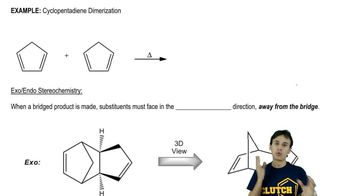
    A configuration where substituents or rings are oriented away from the bridge, minimizing steric hindrance.
  • Exo Orientation

    A configuration where substituents or rings are oriented toward the bridge, often resulting in increased steric interactions.
  • Flagpole Interaction

    Steric repulsion between hydrogens or groups on a bridge and those on a ring, influencing product preference.
  • Mechanistic Arrows

    Curved arrows used to depict electron movement during bond formation and rearrangement in reaction mechanisms.
  • Planar Representation

    A two-dimensional depiction of a molecule, useful for visualizing ring systems but lacking spatial detail.
  • 3D Representation

    A depiction showing the spatial arrangement of atoms, clarifying the positions of bridges and substituents.
  • Substituent

    An atom or group attached to a ring or chain, whose orientation (endo or exo) affects the stability of the product.
  • S-cis Conformation

    A specific arrangement of a diene where the double bonds are on the same side, required for Diels-Alder reactivity.
  • Dimerization

    A process where two identical molecules react to form a single, often more complex, product.
  • Hydrocarbon

    A molecule composed solely of carbon and hydrogen, often drawn without explicit hydrogens unless stereochemistry is relevant.