Back

Decarboxylation Mechanism quiz

Control buttons has been changed to "navigation" mode.
1/15
  • What is decarboxylation in organic chemistry?

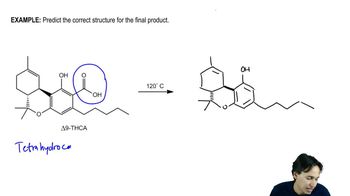
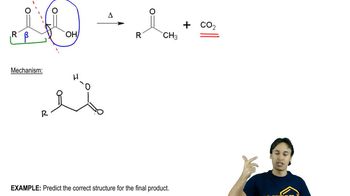
    Decarboxylation is the removal of a carboxylic acid group from a molecule, typically producing CO2 gas and leaving behind a carbonyl group.
  • Which type of carboxylic acid undergoes decarboxylation most readily?

    Beta-keto carboxylic acids undergo decarboxylation most readily when heated.
  • What is the main byproduct of the decarboxylation reaction?

    The main byproduct is carbon dioxide (CO2) gas.
  • What happens to the carboxylic acid group during decarboxylation?

    The entire carboxylic acid group is cleaved off and released as CO2 gas.
  • What is left behind after decarboxylation of a beta-keto carboxylic acid?

    A carbonyl group is left behind after the carboxylic acid is removed.
  • What initiates the mechanism of decarboxylation in the video?

    The mechanism starts with the oxygen atom grabbing a hydrogen atom.
  • How many concerted steps are involved in the decarboxylation mechanism?

    There are four concerted steps in the decarboxylation mechanism.
  • What is the role of heat in the decarboxylation reaction?

    Heat facilitates the cleavage of the carboxylic acid group, enabling the reaction to proceed.
  • What intermediate is formed immediately after decarboxylation?

    An alcohol intermediate, specifically a vinyl alcohol (enol), is formed.
  • What process does the alcohol intermediate undergo after decarboxylation?

    The alcohol intermediate undergoes tautomerization.
  • What is tautomerization?

    Tautomerization is the process where the location of a double bond and a hydrogen atom are switched, converting an enol to a ketone.
  • What is the final product after tautomerization in decarboxylation?

    The final product is a ketone.
  • Why is tautomerization important in enol and enolate chemistry?

    Tautomerization is significant because it allows enols to convert to more stable keto forms, which is a key concept in enol and enolate chemistry.
  • What should you do to better visualize the decarboxylation mechanism?

    Rotating the bond in the molecule helps make the mechanism easier to understand.
  • What happens to the double bond and hydrogen during tautomerization?

    The double bond and hydrogen switch locations, resulting in the formation of a ketone from an enol.