Back

Carboxylic Acid Derivatives quiz

Control buttons has been changed to "navigation" mode.
1/15
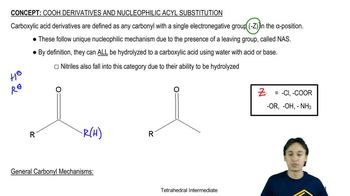
  • What defines a carboxylic acid derivative?

    A carboxylic acid derivative is any carbonyl compound with an electronegative Z group in the alpha position.
  • Why are R and H poor leaving groups in carbonyl chemistry?

    R and H are poor leaving groups because they are not electronegative and form strong bases when they leave.
  • What is the main reaction mechanism for carboxylic acid derivatives?

    The main mechanism is nucleophilic acyl substitution (NAS).
  • How can carboxylic acid derivatives be converted back to carboxylic acids?

    They can be hydrolyzed using water and either acid or base.
  • Why are Z groups important in carboxylic acid derivatives?

    Z groups are better leaving groups than R or H, allowing for nucleophilic acyl substitution.
  • Name three common Z groups found in carboxylic acid derivatives.

    Common Z groups include chlorine, ester (OR), and amide (NH2).
  • Why are nitriles considered carboxylic acid derivatives?

    Nitriles can be hydrolyzed to carboxylic acids, so they are included as derivatives.
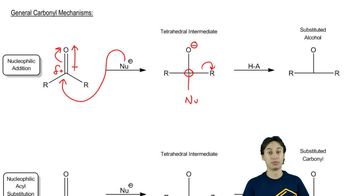
  • What is the key difference between nucleophilic addition and nucleophilic acyl substitution?

    Nucleophilic addition forms a substituted alcohol, while nucleophilic acyl substitution forms a substituted carbonyl.
  • What intermediate is formed when a nucleophile attacks a carbonyl carbon?

    A tetrahedral intermediate is formed.
  • Why does the tetrahedral intermediate in nucleophilic addition usually protonate?

    It protonates because there is no good leaving group to reform the carbonyl.
  • What happens to the Z group during nucleophilic acyl substitution?

    The Z group is expelled as a leaving group when the carbonyl reforms.
  • What is the 'mother' compound of all carboxylic acid derivatives?

    Carboxylic acid is considered the 'mother' compound because all derivatives can be hydrolyzed back to it.
  • How does the presence of a Z group affect the reactivity of the carbonyl carbon?

    The Z group increases the electrophilicity of the carbonyl carbon, making it more reactive to nucleophiles.
  • What is preserved in nucleophilic acyl substitution but not in nucleophilic addition?

    The carbonyl group is preserved in nucleophilic acyl substitution.
  • Why can't R or H leave during nucleophilic addition to ketones or aldehydes?

    R or H can't leave because they are very poor leaving groups, so the intermediate must protonate instead.