Back

Conjugated Hydrohalogenation (1,2 vs 1,4 addition) quiz

Control buttons has been changed to "navigation" mode.
1/15
  • What is the main difference between standard hydrohalogenation and conjugated hydrohalogenation?

    In standard hydrohalogenation, the double bond is fully consumed, while in conjugated hydrohalogenation, one double bond reacts and the other remains for conjugation.
  • What type of intermediate is formed during conjugated hydrohalogenation?

    A carbocation intermediate is formed, which can be stabilized by resonance.
  • Why does conjugated hydrohalogenation produce two possible products?

    Because the carbocation intermediate is stabilized by resonance, allowing the halide to attack at two different positions.
  • What are the names of the two products formed in conjugated hydrohalogenation?

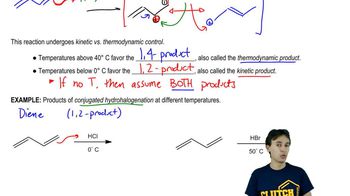
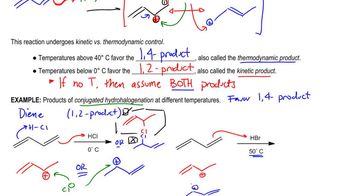
    They are called the 1,2-addition (kinetic) product and the 1,4-addition (thermodynamic) product.
  • How can you control which product is favored in conjugated hydrohalogenation?

    By adjusting the reaction temperature: low temperatures favor the 1,2 (kinetic) product, and high temperatures favor the 1,4 (thermodynamic) product.
  • Which product is favored at temperatures above 40°C in conjugated hydrohalogenation?

    The 1,4-addition (thermodynamic) product is favored at temperatures above 40°C.
  • Which product is favored at temperatures below 0°C in conjugated hydrohalogenation?

    The 1,2-addition (kinetic) product is favored at temperatures below 0°C.
  • Why is the 1,2-addition product called the kinetic product?

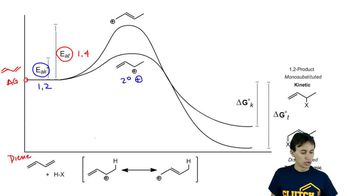
    Because it forms faster due to a more stable intermediate, even though the final product is less stable.
  • Why is the 1,4-addition product called the thermodynamic product?

    Because it is more stable overall due to greater substitution on the double bond, despite forming from a less stable intermediate.
  • What happens if no temperature is specified in a conjugated hydrohalogenation reaction?

    You should assume that both the 1,2 and 1,4 products are formed as a mixture.
  • What is the role of resonance in the mechanism of conjugated hydrohalogenation?

    Resonance allows the carbocation intermediate to be stabilized and creates two possible sites for halide attack.
  • How does the stability of the intermediate differ between the kinetic and thermodynamic pathways?

    The kinetic (1,2) pathway has a more stable secondary carbocation intermediate, while the thermodynamic (1,4) pathway has a less stable primary carbocation intermediate.
  • How does the stability of the final product differ between the kinetic and thermodynamic pathways?

    The kinetic product is less stable (monosubstituted double bond), while the thermodynamic product is more stable (disubstituted double bond).
  • What mnemonic can help you remember which product is favored at high or low temperatures?

    The bigger number (1,4) is favored at higher temperatures, and the smaller number (1,2) is favored at lower temperatures.
  • Why does the thermodynamic product require higher temperatures to form?

    Because it has a higher activation energy barrier, which requires more energy (heat) to overcome.