Back

Conjugated Hydrohalogenation (1,2 vs 1,4 addition) definitions

Control buttons has been changed to "navigation" mode.
1/15
  • Conjugated Hydrohalogenation

    A reaction where a diene and HX yield products with one double bond retained, allowing for resonance-stabilized intermediates.
  • Diene

    A molecule containing two double bonds, enabling unique reactivity with halohydric acids due to conjugation.
  • Halohydric Acid

    A strong acid like HCl or HBr, serving as the electrophile in addition reactions with alkenes or dienes.
  • Carbocation

    A positively charged carbon intermediate, whose stability influences product distribution in addition reactions.
  • Resonance

    Delocalization of electrons across adjacent atoms, stabilizing intermediates and enabling multiple reactive sites.
  • Markovnikov Addition

    A regioselective process where the electrophile attaches to the less substituted carbon, favoring more stable carbocation formation.
  • Allylic Position

    A site adjacent to a double bond, often more reactive and stabilized due to resonance effects.
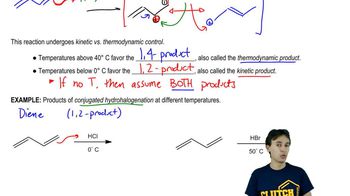
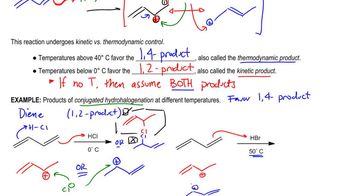
  • 1,2-Addition

    A product where the hydrogen and halogen add to adjacent carbons, favored at low temperatures due to a more stable intermediate.
  • 1,4-Addition

    A product where the hydrogen and halogen add to carbons separated by two positions, favored at high temperatures for greater stability.
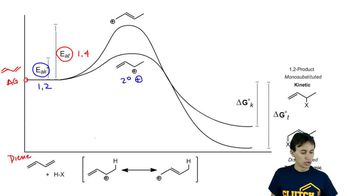
  • Kinetic Product

    The compound formed fastest under cold conditions, resulting from the most stable intermediate but less stable overall structure.
  • Thermodynamic Product

    The most stable compound formed at high temperatures, requiring more energy but yielding a more substituted double bond.
  • Activation Energy

    The energy barrier that must be overcome for a reaction pathway, influencing which product is favored under given conditions.
  • Substitution

    The number of alkyl groups attached to a double bond, affecting its stability and the favorability of reaction products.
  • Reaction Coordinate

    A graphical representation of energy changes during a reaction, illustrating intermediates and product stability.
  • Hyperconjugation

    Stabilization of carbocations or double bonds by adjacent alkyl groups, enhancing product stability in organic reactions.