Organic Chemistry
My Course
Learn
Exam Prep
AI Tutor
Study Guides
Textbook Solutions
Flashcards
Explore
Try the app
My Course
Learn
Exam Prep
AI Tutor
Study Guides
Textbook Solutions
Flashcards
Explore
Try the app
Back
Claisen-Schmidt Condensation quiz
You can tap to flip the card.
What is the Claisen-Schmidt condensation?
You can tap to flip the card.
👆
What is the Claisen-Schmidt condensation?
It is a specific type of crossed aldol reaction involving an enolizable aldehyde and an enolizable ketone.
Track progress
Control buttons has been changed to "navigation" mode.
1/15
Related flashcards
Related practice
Recommended videos
Claisen-Schmidt Condensation definitions
Claisen-Schmidt Condensation
13 Terms
Claisen Condensation
25. Condensation Chemistry
6 problems
Topic

Johnny
22. Condensation Chemistry - Part 1 of 2
3 topics
9 problems
Chapter
Ernest
22. Condensation Chemistry - Part 2 of 2
3 topics
9 problems
Chapter
Johnny
Guided course
02:28
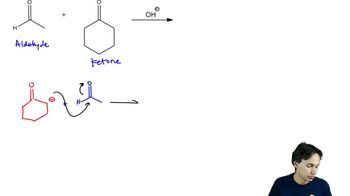
Predict the Major Product
3
views
Guided course
02:10
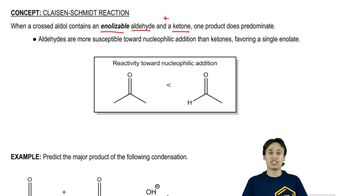
Claisen-Schmidt Reaction
3
views
Terms in this set (15)
Hide definitions
What is the Claisen-Schmidt condensation?
It is a specific type of crossed aldol reaction involving an enolizable aldehyde and an enolizable ketone.
How does the Claisen-Schmidt reaction differ from typical crossed aldol reactions?
Unlike typical crossed aldol reactions, it uses two enolizable carbonyl compounds and still predominantly yields a single product.
Why are crossed aldol reactions usually performed with one non-enolizable carbonyl compound?
This prevents multiple products from forming, making the reaction more selective.
What is meant by 'enolizable' in the context of carbonyl compounds?
An enolizable compound has alpha hydrogens that can be deprotonated to form an enolate ion.
Why does the Claisen-Schmidt reaction favor the formation of one product?
Aldehydes are more susceptible to nucleophilic addition than ketones, so the reaction favors one enolate over the other.
In the Claisen-Schmidt reaction, which compound typically acts as the electrophile?
The aldehyde typically acts as the electrophile because it is more reactive toward nucleophilic addition.
What role does the ketone play in the Claisen-Schmidt condensation?
The ketone usually forms the enolate, which attacks the aldehyde.
What would theoretically happen if both the aldehyde and ketone formed enolates in the Claisen-Schmidt reaction?
Multiple products could form, leading to a mixture, but in practice, only one product predominates.
Why is the Claisen-Schmidt reaction considered an exception to the rule about crossed aldol reactions?
It allows both reactants to be enolizable and still produces mainly one product.
What is the major product of a Claisen-Schmidt condensation between an enolizable ketone and an enolizable aldehyde?
The major product is the result of the enolate from the ketone attacking the aldehyde.
How does the susceptibility of aldehydes to nucleophilic addition affect the Claisen-Schmidt reaction?
It makes the aldehyde more likely to be attacked, favoring its role as the electrophile.
What is the significance of the Punnett square analogy in the Claisen-Schmidt reaction?
It illustrates the potential for multiple products, but in reality, only one product predominates.
Can both the ketone and aldehyde form enolates in the Claisen-Schmidt reaction?
Yes, both can theoretically form enolates, but only the ketone enolate reacts predominantly.
What is encouraged when predicting the outcome of a Claisen-Schmidt condensation?
Students should predict the major product formed when both reactants are enolizable.
Why does the Claisen-Schmidt reaction not result in a mess of products despite both reactants being enolizable?
Because the aldehyde is more reactive as an electrophile, the reaction is selective and yields mainly one product.