Back

Claisen-Schmidt Condensation definitions

Control buttons has been changed to "navigation" mode.
1/13
  • Claisen-Schmidt Condensation

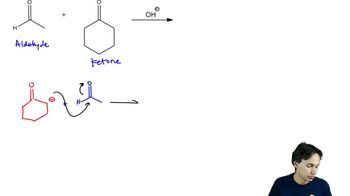
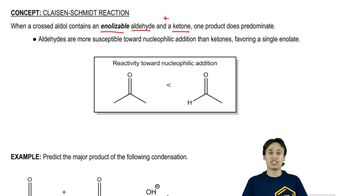
    A crossed aldol process using both an enolizable aldehyde and ketone, yet yielding mainly one product due to reactivity differences.
  • Crossed Aldol Reaction

    A reaction between two different carbonyl compounds, potentially forming multiple products unless selectivity is achieved.
  • Enolizable Aldehyde

    A carbonyl compound with at least one alpha hydrogen, allowing it to form an enolate under basic conditions.
  • Enolizable Ketone

    A ketone possessing alpha hydrogens, enabling enolate formation and participation in condensation reactions.
  • Enolate

    A resonance-stabilized anion formed by deprotonation at the alpha carbon of a carbonyl compound.
  • Nucleophilic Addition

    A process where a nucleophile attacks an electrophilic carbonyl carbon, leading to bond formation.
  • Electrophile

    A species that accepts electrons during a reaction, often the carbonyl carbon in condensation reactions.
  • Alpha Hydrogen

    A hydrogen atom attached to the carbon adjacent to a carbonyl group, essential for enolate formation.
  • Major Product

    The predominant compound formed in a reaction, favored by reactivity or selectivity factors.
  • Punnett Square

    A diagrammatic tool used to predict possible product combinations in crossed reactions.
  • Carbonyl Compound

    A molecule containing a carbon-oxygen double bond, such as an aldehyde or ketone.
  • Reactivity

    The tendency of a molecule to undergo chemical change, influencing product distribution in reactions.
  • Cross Product

    A compound formed from the reaction of two different carbonyl partners in a crossed aldol process.