Back

Claisen Condensation quiz

Control buttons has been changed to "navigation" mode.
1/15
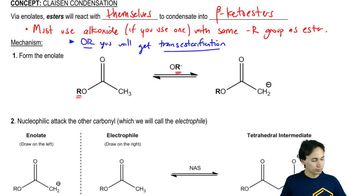
  • What type of functional group is always formed at the end of a Claisen condensation?

    A beta ketoester is always formed at the end of a Claisen condensation.
  • What is the first step in the Claisen condensation mechanism?

    The first step is deprotonating the ester to form the enolate.
  • Why must the alkoxide base used in Claisen condensation have the same R group as the ester?

    To avoid transesterification, which would change the expected product of the reaction.
  • What happens if you use an alkoxide base with a different R group than the ester in Claisen condensation?

    You will get transesterification instead of the Claisen condensation product.
  • In the Claisen condensation, what does the enolate attack?

    The enolate attacks the carbonyl carbon of another ester molecule.
  • What is the leaving group in the Claisen condensation mechanism?

    The OR group (alkoxy group) acts as the leaving group.
  • What type of reaction mechanism is the Claisen condensation classified as?

    It is a nucleophilic acyl substitution (NAS) reaction.
  • Why is it important to draw the OR group towards the enolate when predicting Claisen condensation products?

    Drawing the OR group towards the enolate helps accurately predict the product by showing the correct orientation for the nucleophilic attack.
  • What is the significance of beta ketoesters in organic synthesis?

    Beta ketoesters, such as acetoacetic ester, are important intermediates that can be transformed into various other compounds.
  • What is the product called when ethyl acetate undergoes Claisen condensation with itself?

    The product is called acetoacetic ester.
  • What intermediate is formed after the nucleophilic attack in Claisen condensation?

    A tetrahedral intermediate is formed after the nucleophilic attack.
  • What does NAS stand for in the context of Claisen condensation?

    NAS stands for nucleophilic acyl substitution.
  • Why does the Claisen condensation not result in nucleophilic addition?

    Because the OR group is a good leaving group, the reaction proceeds via substitution rather than addition.
  • What is the role of the base in the Claisen condensation?

    The base deprotonates the ester to generate the enolate nucleophile.
  • How does Claisen condensation link to broader organic chemistry concepts?

    It demonstrates nucleophilic acyl substitution and the formation of important synthetic intermediates like beta ketoesters.