Organic Chemistry
My Course
Learn
Exam Prep
AI Tutor
Study Guides
Textbook Solutions
Flashcards
Explore
Try the app
My Course
Learn
Exam Prep
AI Tutor
Study Guides
Textbook Solutions
Flashcards
Explore
Try the app
Back
Claisen Condensation definitions
You can tap to flip the card.
Claisen Condensation
You can tap to flip the card.
👆
Claisen Condensation
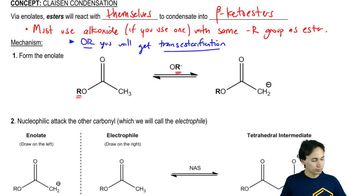
A reaction where two esters combine, forming a beta ketoester via enolate formation and nucleophilic acyl substitution.
Track progress
Control buttons has been changed to "navigation" mode.
1/13
Related flashcards
Related practice
Recommended videos
Claisen Condensation quiz
Claisen Condensation
15 Terms
Claisen Condensation
25. Condensation Chemistry
6 problems
Topic

Johnny
Intramolecular Aldol Condensation
25. Condensation Chemistry
4 problems
Topic

Laura
22. Condensation Chemistry - Part 1 of 2
3 topics
9 problems
Chapter
Ernest
22. Condensation Chemistry - Part 2 of 2
3 topics
9 problems
Chapter
Johnny
Guided course
08:28
Claisen Condensation
2
views
Terms in this set (13)
Hide definitions
Claisen Condensation
A reaction where two esters combine, forming a beta ketoester via enolate formation and nucleophilic acyl substitution.
Ester
A compound featuring a carbonyl bonded to an OR group, serving as both enolate precursor and electrophile in this reaction.
Enolate
A resonance-stabilized anion formed by deprotonating an alpha hydrogen of an ester, acting as a nucleophile.
Beta Ketoester
A molecule containing both a ketone and an ester group separated by one carbon, the hallmark product of Claisen condensation.
Alkoxide Base
A strong base with an OR group, used to deprotonate esters; must match the ester’s R group to avoid transesterification.
Transesterification
A side reaction where the ester’s OR group is replaced by another, altering the expected product if mismatched alkoxide is used.
Nucleophilic Acyl Substitution
A mechanism where a nucleophile replaces a leaving group (like OR) on a carbonyl, central to Claisen condensation.
Tetrahedral Intermediate
A transient structure formed when a nucleophile attacks a carbonyl carbon, leading to substitution or elimination.
Leaving Group
An atom or group (such as OR) that departs with electron pair during nucleophilic acyl substitution.
Alpha Carbon
The carbon atom directly adjacent to the carbonyl group, site of enolate formation and substitution.
Electrophile
A species, such as a non-enolate ester, that accepts electrons from a nucleophile during the condensation.
Acetoacetic Ester
A specific beta ketoester derived from ethyl acetate, widely used as a synthetic intermediate in organic chemistry.
Carboxylic Acid Derivative
A class of compounds including esters, characterized by a carbonyl bonded to a heteroatom, reactive in NAS mechanisms.