Back

Calculations with Enantiomeric Percentages quiz

Control buttons has been changed to "navigation" mode.
1/15
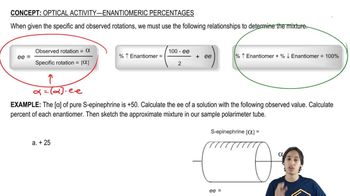
  • What is the equation relating observed rotation, specific rotation, and enantiomeric excess (ee)?

    Observed rotation equals specific rotation times enantiomeric excess (ee).
  • How do you solve for enantiomeric excess (ee) if given observed and specific rotation?

    Enantiomeric excess (ee) is calculated by dividing the observed rotation by the specific rotation.
  • What is the sum of the percentages of the higher and lower enantiomers in a mixture?

    The sum of the percentages of the higher and lower enantiomers always equals 100%.
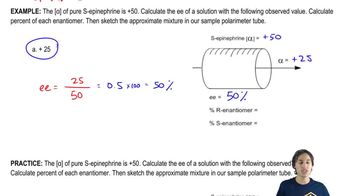
  • If the specific rotation of pure s-epinephrine is +50 and the observed rotation is +25, what does this indicate about the mixture?

    It indicates that the mixture contains both enantiomers and is not pure s-epinephrine.
  • How do you calculate the percentage of the higher enantiomer from most enantiomeric excess values?

    You use the formula: percentage of higher enantiomer = (enantiomeric excess + 100) / 2.
  • How do you find the percentage of the lower enantiomer once you know the higher enantiomer's percentage?

    Subtract the percentage of the higher enantiomer from 100% to get the lower enantiomer's percentage.
  • What does an observed rotation of +25 mean if the specific rotation is +50?

    It means the enantiomeric excess is 50%, indicating a mixture with more of the s-enantiomer but not pure.
  • Why is the observed rotation less than the specific rotation in a mixture of enantiomers?

    Because the presence of both enantiomers causes partial cancellation of optical activity, reducing the observed rotation.
  • What is the enantiomeric excess (ee) if the observed rotation is +25 and the specific rotation is +50?

    The enantiomeric excess (ee) is 50%.
  • If the enantiomeric excess is 50%, what are the percentages of the higher and lower enantiomers?

    The higher enantiomer is 75% and the lower enantiomer is 25%.
  • What does a 50:50 mixture of enantiomers result in regarding optical rotation?

    A 50:50 mixture results in zero observed optical rotation because the rotations cancel each other out.
  • How can you visualize the mixture of enantiomers in a polarimeter tube?

    You can sketch the tube with sections representing the percentages of each enantiomer, such as 75% s and 25% r.
  • Why do we only get half the efficacy (rotation) when the mixture is not pure?

    Because the lower enantiomer partially cancels the optical activity of the higher enantiomer, reducing the observed rotation.
  • What is the relationship between enantiomeric excess and optical activity?

    Enantiomeric excess directly determines the proportion of optical activity observed compared to the pure enantiomer.
  • What is the first step in solving for enantiomeric percentages when given observed and specific rotation?

    The first step is to calculate the enantiomeric excess (ee) using the observed and specific rotation values.