Back

Calculations with Enantiomeric Percentages definitions

Control buttons has been changed to "navigation" mode.
1/15
  • Optical Activity

    A property where a compound rotates plane-polarized light, indicating the presence of chiral molecules in a sample.
  • Specific Rotation

    A standardized measure of a compound's ability to rotate plane-polarized light, given as degrees per concentration and path length.
  • Observed Rotation

    The actual measured angle by which a sample rotates plane-polarized light, reflecting the mixture's composition.
  • Enantiomeric Excess

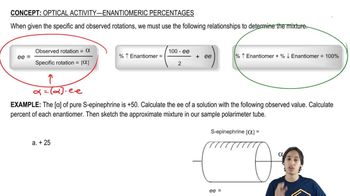
    A value expressing the difference in percentage between two enantiomers in a mixture, indicating optical purity.
  • Enantiomer

    One of a pair of molecules that are non-superimposable mirror images, often labeled as 'R' or 'S'.
  • Polarimeter

    An instrument used to measure the angle of rotation caused by optically active substances.
  • Mixture

    A sample containing more than one enantiomer, resulting in reduced optical rotation compared to a pure sample.
  • Percentage Composition

    The proportion of each enantiomer present in a sample, typically adding up to 100%.
  • Higher Enantiomer

    The enantiomer present in greater proportion within a mixture, contributing more to optical rotation.
  • Lower Enantiomer

    The enantiomer present in lesser proportion within a mixture, reducing the net optical rotation.
  • S-Epinephrine

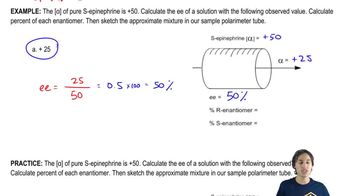
    A specific chiral form of epinephrine with a positive specific rotation, used as a reference in calculations.
  • R-Epinephrine

    The enantiomeric counterpart to S-epinephrine, contributing oppositely to optical rotation in mixtures.
  • Chirality

    A geometric property where a molecule cannot be superimposed on its mirror image, leading to enantiomer formation.
  • Equation Rearrangement

    A mathematical manipulation to solve for a desired variable, such as enantiomeric excess or enantiomer percentages.
  • Plane-Polarized Light

    Light oscillating in a single plane, used in polarimetry to detect optical activity in chiral samples.