Back

Buchwald-Hartwig Amination Reaction quiz

Control buttons has been changed to "navigation" mode.
1/15
  • What is the main purpose of the Buchwald-Hartwig amination reaction?

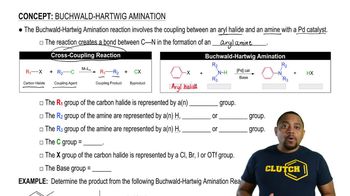
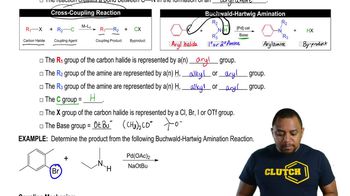
    To couple an aryl halide and an amine using a palladium catalyst, forming a carbon-nitrogen bond and producing an aryl amine.
  • Which catalyst is used in the Buchwald-Hartwig amination reaction?

    A palladium complex is used as the catalyst.
  • What type of amine is typically used in the Buchwald-Hartwig amination reaction?

    Primary or secondary amines are typically used, as the nitrogen must have at least one hydrogen.
  • What are common leaving groups in the aryl halide for this reaction?

    Chlorine, bromine, iodine, or triflate are common leaving groups.
  • What base is commonly used in the Buchwald-Hartwig amination reaction?

    Terbutoxide (OTBU-) is commonly used as the base.
  • What is the first step in the Buchwald-Hartwig amination mechanism?

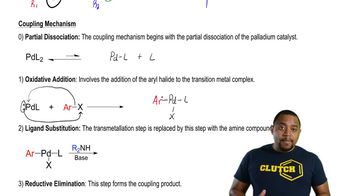
    Partial dissociation of the palladium catalyst, where one ligand leaves the palladium complex.
  • What happens during the oxidative addition step?

    The aryl halide adds to the palladium complex, forming a bond between palladium and the aryl group as well as the leaving group.
  • How does the amine attach to the palladium during ligand substitution?

    The nitrogen uses its lone pair to bond to the palladium, displacing the halide group.
  • Why is the nitrogen initially positively charged after ligand substitution?

    Because it forms four bonds, which gives it a positive charge until deprotonated by the base.
  • What role does the base play in the ligand substitution step?

    The base deprotonates the nitrogen, neutralizing its charge.
  • What is formed during the reductive elimination step?

    The carbon-nitrogen bond is formed, producing the aryl amine and regenerating the palladium catalyst.
  • How does the Buchwald-Hartwig amination differ from other cross-coupling reactions in its first step?

    It starts with partial dissociation of the palladium catalyst instead of oxidative addition.
  • What is the generic formula for a cross-coupling reaction as applied to Buchwald-Hartwig amination?

    An aryl halide (R1-X) reacts with an amine (R2-NH-R3) in the presence of a palladium catalyst and base to form an aryl amine.
  • What is the fundamental change occurring in the reaction, in simple terms?

    The leaving group (X) from the aryl halide and a hydrogen from the amine are lost, and the remaining groups combine to form the aryl amine.
  • What is regenerated at the end of the Buchwald-Hartwig amination reaction?

    The palladium catalyst is regenerated, allowing the reaction to be catalytic.