Organic Chemistry
My Course
Learn
Exam Prep
AI Tutor
Study Guides
Textbook Solutions
Flashcards
Explore
Try the app
My Course
Learn
Exam Prep
AI Tutor
Study Guides
Textbook Solutions
Flashcards
Explore
Try the app
Back
Buchwald-Hartwig Amination Reaction definitions
You can tap to flip the card.
Aryl Halide
You can tap to flip the card.
👆
Aryl Halide
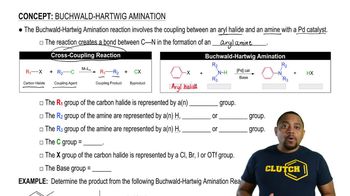
An aromatic ring bonded to a halogen or triflate, serving as the electrophilic partner in cross-coupling reactions.
Track progress
Control buttons has been changed to "navigation" mode.
1/15
Related flashcards
Related practice
Recommended videos
Buchwald-Hartwig Amination Reaction quiz
Buchwald-Hartwig Amination Reaction
15 Terms
Buchwald-Hartwig Amination Reaction
35. Transition Metals
2 problems
Topic

Ernest
27. Transition Metals
6 topics
14 problems
Chapter
Johnny
Guided course
03:46
Buchwald-Hartwig Amination Reaction
2
views
Guided course
05:13
Buchwald-Hartwig Amination Reaction
3
views
Guided course
01:25
Buchwald-Hartwig Amination Reaction Example 1
2
views
Terms in this set (15)
Hide definitions
Aryl Halide
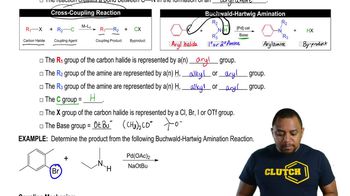
An aromatic ring bonded to a halogen or triflate, serving as the electrophilic partner in cross-coupling reactions.
Amine
A nitrogen-containing compound, typically primary or secondary, acting as the nucleophilic partner in the coupling process.
Palladium Catalyst
A transition metal complex that facilitates bond formation by cycling through oxidation states during the reaction.
Carbon-Nitrogen Bond
A covalent linkage formed between a carbon atom of an aromatic ring and a nitrogen atom from an amine.
Aryl Amine
A product featuring an aromatic ring directly attached to a nitrogen atom, resulting from the coupling process.
Cross-Coupling Reaction
A process where two different molecular fragments are joined together using a metal catalyst, forming a new bond.
Ligand
A molecule or ion bound to a metal center, influencing the reactivity and stability of the catalyst.
Oxidative Addition
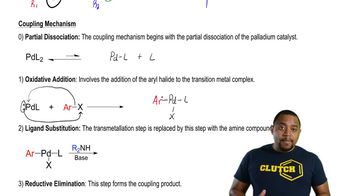
A step where the metal inserts into a bond, increasing its oxidation state and forming new metal-ligand connections.
Ligand Substitution
A mechanism step where a ligand on the metal is replaced by another, such as an amine displacing a halide.
Reductive Elimination
A process where two groups on a metal center couple and detach, regenerating the catalyst and forming the product.
Base
A substance, often tert-butoxide, that removes a proton from the amine, neutralizing charge and enabling product formation.
Leaving Group
An atom or group, such as halide or triflate, that departs from the substrate, facilitating bond formation.
Partial Dissociation
An initial step where a ligand detaches from the metal catalyst, creating an active species for the reaction.
Transition Metal Complex
A structure consisting of a central metal atom bonded to surrounding ligands, crucial for catalytic activity.
Transmetalation
A step analogous to ligand substitution, involving the transfer of a group to the metal, though here replaced by amine coordination.