Back

Beta-Dicarbonyl Synthesis Pathway quiz

Control buttons has been changed to "navigation" mode.
1/15
  • Why are beta dicarbonyl compounds more acidic than normal alpha carbons?

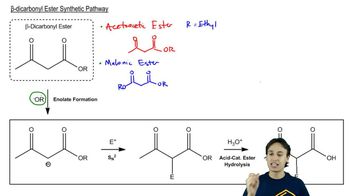
    Beta dicarbonyl compounds are more acidic because the enolate formed is highly stabilized, lowering the pKa to around 10 compared to 20 for normal alpha carbons.
  • What is the typical pKa of a beta dicarbonyl compound's alpha hydrogen?

    The pKa is about 10, making it much easier to deprotonate than a normal alpha carbon.
  • Name the two main types of beta dicarbonyl esters used in this synthesis pathway.

    The two main types are acetoacetic ester and malonic ester.
  • Why must the base used for enolate formation have the same R group as the ester?

    The base must have the same R group to prevent transesterification, which would otherwise alter the ester group.
  • What is the first step in the beta dicarbonyl ester synthesis pathway?

    The first step is enolate formation by deprotonating the alpha hydrogen with a suitable base.
  • What reaction does the enolate undergo after it is formed?

    The enolate attacks an electrophile, typically through an SN2 mechanism, to add an R group to the alpha carbon.
  • What is the purpose of acid-catalyzed ester hydrolysis in this pathway?

    Acid-catalyzed ester hydrolysis converts the ester group into a carboxylic acid.
  • What happens to beta carbonyl carboxylic acids when heated?

    They undergo decarboxylation, releasing CO2 and leaving behind an alpha-substituted carbonyl compound.
  • What is the final organic product of the beta dicarbonyl synthesis pathway?

    The final product is an alpha-substituted carbonyl compound.
  • Why does this synthesis pathway often give higher yields than direct enolate alkylation?

    It gives higher yields because the enolate is more easily formed due to the lower pKa of the beta dicarbonyl compound.
  • What is malonic ester structurally?

    Malonic ester is a three-carbon chain with two ester groups, one on each end.
  • What is the main advantage of using beta dicarbonyl compounds for alpha substitution?

    The main advantage is the increased acidity and stability of the enolate, making the reaction more efficient.
  • What gas is released during the decarboxylation step?

    Carbon dioxide (CO2) is released.
  • What is transesterification and why is it undesirable in this pathway?

    Transesterification is the exchange of ester groups, which can complicate the reaction and reduce yield if the base's R group doesn't match the ester.
  • What is the role of heat in the final step of the beta dicarbonyl synthesis pathway?

    Heat induces decarboxylation, removing the carboxyl group as CO2 and yielding the desired alpha-substituted product.