Back

Beta-Dicarbonyl Synthesis Pathway definitions

Control buttons has been changed to "navigation" mode.
1/14
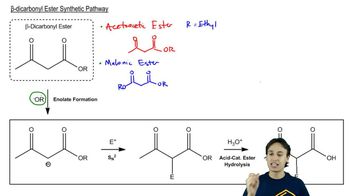
  • Beta Dicarbonyl

    A molecule with two carbonyl groups separated by one carbon, greatly increasing the acidity of the central hydrogen.
  • Alpha Carbon

    The carbon atom directly adjacent to a carbonyl group, often the site for substitution in synthesis pathways.
  • Enolate

    A resonance-stabilized anion formed by deprotonation of an alpha hydrogen, highly nucleophilic and reactive.
  • pKa

    A numerical value indicating the acidity of a hydrogen atom; lower values mean higher acidity and easier deprotonation.
  • Acetoacetic Ester

    A beta dicarbonyl ester commonly used to introduce R groups at the alpha position via enolate chemistry.
  • Malonic Ester

    A three-carbon diester with two ester groups, used for alpha substitution and subsequent decarboxylation.
  • Transesterification

    A process where the alkoxy group of an ester is exchanged with another alcohol, potentially altering the ester structure.
  • Electrophile

    A species that accepts electrons during a reaction, allowing nucleophilic attack by enolates.
  • SN2 Reaction

    A bimolecular nucleophilic substitution mechanism where a nucleophile attacks an electrophile in a single concerted step.
  • Ester Hydrolysis

    A reaction where an ester is converted into a carboxylic acid using acid and water, often as a key step in synthesis.
  • Carboxylic Acid

    A functional group formed from ester hydrolysis, characterized by a carbonyl and hydroxyl group on the same carbon.
  • Decarboxylation

    A reaction where a carboxyl group is removed from a molecule as CO2, often facilitated by heat in beta carbonyl acids.
  • Alpha Substituted Carbonyl

    A carbonyl compound where the alpha carbon bears a new substituent, typically introduced via enolate chemistry.
  • Carboxylic Acid Derivative

    A compound related to carboxylic acids, such as esters, that can be converted to acids through hydrolysis.