Organic Chemistry
My Course
Learn
Exam Prep
AI Tutor
Study Guides
Textbook Solutions
Flashcards
Explore
Try the app
My Course
Learn
Exam Prep
AI Tutor
Study Guides
Textbook Solutions
Flashcards
Explore
Try the app
Back
Basicity of Aromatic Heterocycles quiz
You can tap to flip the card.
What type of reaction occurs when an aromatic heterocycle like imidazole reacts with a strong acid (HX)?
You can tap to flip the card.
👆
What type of reaction occurs when an aromatic heterocycle like imidazole reacts with a strong acid (HX)?
It is an acid-base reaction involving lone pairs on the heterocycle, not affecting the aromatic ring itself.
Track progress
Control buttons has been changed to "navigation" mode.
1/15
Related flashcards
Related practice
Recommended videos
Basicity of Aromatic Heterocycles definitions
Basicity of Aromatic Heterocycles
15 Terms
Basicity of Aromatic Heterocycles
18. Aromaticity
3 problems
Topic

Johnny
Ionization of Aromatics
18. Aromaticity
1 problem
Topic

Nicole
17. Aromaticity - Part 1 of 2
6 topics
13 problems
Chapter
Johnny
17. Aromaticity - Part 2 of 2
5 topics
12 problems
Chapter
Ernest
Guided course
02:54
The Sp2 Rule
2
views
Guided course
02:04
Heterocycles - Which lone pairs react?
3
views
Guided course
03:55
Draw the acid/base reaction product
1
views
Terms in this set (15)
Hide definitions
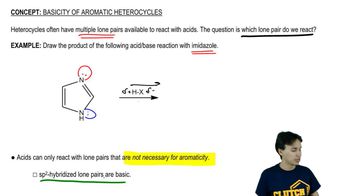
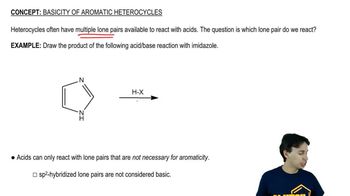
What type of reaction occurs when an aromatic heterocycle like imidazole reacts with a strong acid (HX)?
It is an acid-base reaction involving lone pairs on the heterocycle, not affecting the aromatic ring itself.
Why are aromatic compounds generally unreactive?
They are extremely stable due to aromaticity, making them reluctant to undergo reactions.
Which lone pair on imidazole should react with HX to maintain aromaticity?
The lone pair not involved in maintaining aromaticity (the red lone pair) should react with HX.
What happens if the lone pair necessary for aromaticity reacts with HX?
The molecule would lose its aromaticity and become less stable.
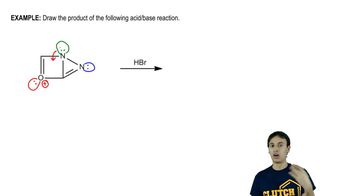
How do you determine which lone pair on a heterocycle is available for reaction with an acid?
Choose the lone pair that is not required to maintain the aromaticity of the ring.
What is the basicity difference between the red and blue lone pairs on imidazole?
Both are basic, but the red lone pair is significantly more basic because it is not needed for aromaticity.
What hybridization is associated with basic lone pairs in aromatic heterocycles?
Sp2 hybridized lone pairs are basic and not required for aromaticity.
Why is the blue lone pair on imidazole less likely to react with HX?
Because it is necessary for maintaining aromaticity, reacting with it would disrupt the ring's stability.
What features must be preserved in the product to maintain aromaticity after reaction with HX?
The molecule must remain planar, fully conjugated, and follow Huckel's rule.
What is Huckel's rule for aromatic stability?
Aromatic molecules must have 4n+2 π electrons, where n is an integer.
What is the result of reacting imidazole with HX at the correct nitrogen?
A hydrogen attaches to the red nitrogen, giving it a positive charge, while aromaticity is preserved.
Are carbons in imidazole basic enough to react with strong acids?
No, only the lone pairs on the nitrogens are basic enough to react with strong acids.
Why is it important to pick the correct heteroatom for acid-base reactions in aromatic heterocycles?
Picking the wrong atom can disrupt aromaticity and make the molecule non-aromatic and less stable.
Can both lone pairs on imidazole react with HX?
Both are basic, but only the red lone pair should react to preserve aromaticity.
What is the main challenge when reacting aromatic heterocycles with strong acids?
The main challenge is identifying which lone pair is available for reaction without disrupting aromaticity.