Back

Basicity of Aromatic Heterocycles definitions

Control buttons has been changed to "navigation" mode.
1/15
  • Aromatic Heterocycle

    A ring structure containing at least one non-carbon atom, exhibiting aromatic stability and unique reactivity with acids.
  • Imidazole

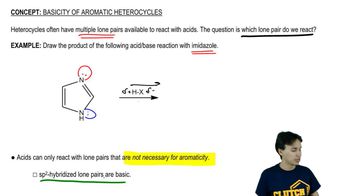
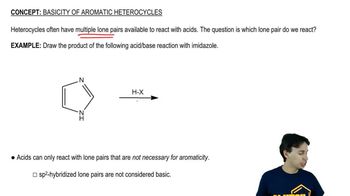
    A five-membered aromatic ring with two nitrogens, often used to illustrate basicity and acid reactions in heterocycles.
  • Lone Pair

    A pair of valence electrons on an atom, not involved in bonding, that can participate in acid-base reactions.
  • Aromaticity

    A property of cyclic, planar molecules with delocalized electrons, conferring exceptional stability and resistance to reaction.
  • HX

    A strong halohydric acid, such as HCl, used to probe the basicity of heterocyclic compounds in acid-base reactions.
  • Acid-Base Reaction

    A process where a proton is transferred from an acid to a basic site, often a lone pair, without disrupting aromaticity.
  • Planarity

    A geometric requirement for aromaticity, ensuring all atoms in a ring lie in the same plane for electron delocalization.
  • Conjugation

    A system where p orbitals overlap across adjacent atoms, allowing electron delocalization and contributing to aromatic stability.
  • Huckel's Rule

    A criterion stating that aromatic rings must have 4n+2 π electrons, ensuring maximum stability and aromatic character.
  • Hybridization

    The mixing of atomic orbitals, such as sp2 or sp3, influencing the basicity and reactivity of lone pairs in heterocycles.
  • Basicity

    A measure of how readily a site, often a lone pair, can accept a proton, influenced by its involvement in aromaticity.
  • Heteroatom

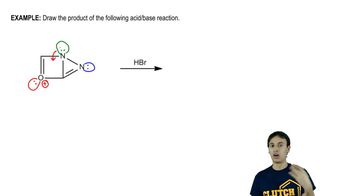
    A non-carbon atom, such as nitrogen, within a ring, often bearing lone pairs that can participate in acid-base chemistry.
  • Protonation

    The addition of a hydrogen ion to a basic site, typically a lone pair, which can alter charge but must preserve aromaticity.
  • Sp2 Hybridized Lone Pair

    A non-bonding electron pair on an sp2 hybridized atom, more available for protonation if not involved in aromaticity.
  • Aromatic Stability

    The enhanced resistance to reaction and energy lowering due to electron delocalization in a planar, conjugated ring.