Organic Chemistry
My Course
Learn
Exam Prep
AI Tutor
Study Guides
Textbook Solutions
Flashcards
Explore
Try the app
My Course
Learn
Exam Prep
AI Tutor
Study Guides
Textbook Solutions
Flashcards
Explore
Try the app
Back
Base-Catalyzed Alpha-Halogentation quiz
You can tap to flip the card.
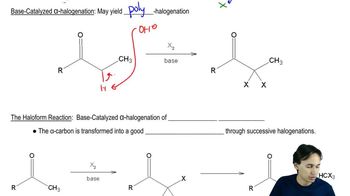
What is the main difference between base-catalyzed and acid-catalyzed alpha-halogenation regarding the number of halogenations?
You can tap to flip the card.
👆
What is the main difference between base-catalyzed and acid-catalyzed alpha-halogenation regarding the number of halogenations?
Base-catalyzed alpha-halogenation can lead to polyhalogenation, while acid-catalyzed typically results in only one substitution.
Track progress
Control buttons has been changed to "navigation" mode.
1/15
Related flashcards
Related practice
Recommended videos
Base-Catalyzed Alpha-Halogentation definitions
Base-Catalyzed Alpha-Halogentation
13 Terms
Haloform Reaction
24. Enolate Chemistry: Reactions at the Alpha-Carbon
2 problems
Topic

Ernest
21. Enolate Chemistry:Reactions at the Alpha-Carbon - Part 1 of 2
7 topics
13 problems
Chapter
Johnny
21. Enolate Chemistry:Reactions at the Alpha-Carbon - Part 2 of 2
5 topics
12 problems
Chapter
Johnny
Guided course
01:57
Base Catalyzed
3
views
Terms in this set (15)
Hide definitions
What is the main difference between base-catalyzed and acid-catalyzed alpha-halogenation regarding the number of halogenations?
Base-catalyzed alpha-halogenation can lead to polyhalogenation, while acid-catalyzed typically results in only one substitution.
What role does the base (such as OH-) play in base-catalyzed alpha-halogenation?
The base deprotonates the alpha carbon to form an enolate, which then reacts with the halogen.
Why does polyhalogenation occur in base-catalyzed alpha-halogenation?
Polyhalogenation occurs because each halogen added stabilizes the enolate, making further substitution of alpha hydrogens easier.
What is required for polyhalogenation to occur in base-catalyzed alpha-halogenation?
Multiple alpha protons are required; if only one alpha proton is present, only one substitution occurs.
What is an enolate and how is it formed in this reaction?
An enolate is a resonance-stabilized anion formed when a base removes an alpha proton from a carbonyl compound.
How does the presence of a halogen on the alpha carbon affect further halogenation?
The halogen stabilizes the negative charge on the enolate, making it easier for additional alpha hydrogens to be substituted.
What happens when all alpha protons are replaced in base-catalyzed alpha-halogenation?
The reaction stops because there are no more alpha protons available for substitution.
Why is the term 'may yield' used instead of 'will yield' for polyhalogenation?
'May yield' is used because polyhalogenation only occurs if there are multiple alpha protons available.
What is the general outcome when a compound with only one alpha proton undergoes base-catalyzed alpha-halogenation?
Only one halogenation occurs, as there is only one alpha proton to substitute.
What is the role of X2 in base-catalyzed alpha-halogenation?
X2 acts as the halogen source that reacts with the enolate to substitute an alpha hydrogen with a halogen.
How does the reactivity of the alpha carbon change after the first halogenation?
The alpha carbon becomes more reactive toward further halogenation due to stabilization by the first halogen.
What is the significance of the negative charge on the enolate in this mechanism?
The negative charge allows the enolate to attack the halogen molecule, facilitating substitution.
What is an application of alpha-halogenation mentioned in the lesson?
An application is the haloform reaction, which will be discussed in the next video.
What happens if you keep adding base and halogen to a compound with multiple alpha protons?
The reaction continues until all alpha protons are replaced by halogens.
Why is base-catalyzed alpha-halogenation considered 'interesting' compared to other mechanisms?
Because it can lead to complete substitution of all alpha hydrogens, resulting in polyhalogenation.