Organic Chemistry
My Course
Learn
Exam Prep
AI Tutor
Study Guides
Textbook Solutions
Flashcards
Explore
Try the app
My Course
Learn
Exam Prep
AI Tutor
Study Guides
Textbook Solutions
Flashcards
Explore
Try the app
Back
Base-Catalyzed Alpha-Halogentation definitions
You can tap to flip the card.
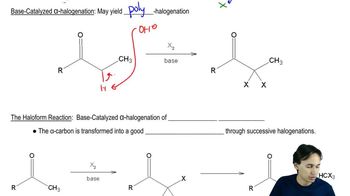
Base-Catalyzed Mechanism
You can tap to flip the card.
👆
Base-Catalyzed Mechanism
A process where a base generates a reactive intermediate, enabling substitution at specific positions adjacent to a carbonyl.
Track progress
Control buttons has been changed to "navigation" mode.
1/13
Related flashcards
Related practice
Recommended videos
Base-Catalyzed Alpha-Halogentation quiz
Base-Catalyzed Alpha-Halogentation
15 Terms
Haloform Reaction
24. Enolate Chemistry: Reactions at the Alpha-Carbon
2 problems
Topic

Ernest
21. Enolate Chemistry:Reactions at the Alpha-Carbon - Part 1 of 2
7 topics
13 problems
Chapter
Johnny
21. Enolate Chemistry:Reactions at the Alpha-Carbon - Part 2 of 2
5 topics
12 problems
Chapter
Johnny
Guided course
01:57
Base Catalyzed
3
views
Terms in this set (13)
Hide definitions
Base-Catalyzed Mechanism
A process where a base generates a reactive intermediate, enabling substitution at specific positions adjacent to a carbonyl.
Polyhalogenation
A transformation resulting in multiple halogen atoms replacing hydrogens at reactive sites, often until none remain.
Alpha Proton
A hydrogen atom directly bonded to the carbon adjacent to a carbonyl group, crucial for substitution reactions.
Enolate
A resonance-stabilized intermediate with a negative charge on the alpha carbon, formed by deprotonation next to a carbonyl.
Halogen Source
A reagent, such as X2, that provides halogen atoms for substitution at reactive positions in organic molecules.
Negative Charge Stabilization
An effect where electron-withdrawing groups, like halogens, make it easier to form and maintain a negative charge on a molecule.
Alpha Hydrogen Substitution
A process where hydrogens adjacent to a carbonyl are replaced by other atoms, typically halogens, via a reactive intermediate.
Polysubstitution
A sequence of reactions where multiple substituents replace hydrogens at the same reactive site, often until depletion.
OH-
A strong base commonly used to abstract protons and initiate the formation of reactive intermediates in organic reactions.
Dipole
A separation of charge within a molecule, influencing reactivity and stabilization of intermediates during reactions.
Haloform Reaction
A specific application where exhaustive halogenation of a methyl ketone leads to the formation of a trihalomethyl compound and a carboxylate.
Alpha Carbon
The carbon atom directly adjacent to a carbonyl group, serving as the site for enolate formation and subsequent substitution.
Halogenation
A chemical process involving the introduction of halogen atoms into an organic molecule, often at reactive positions.