What does the Baeyer-Villiger oxidation convert ketones and aldehydes into?
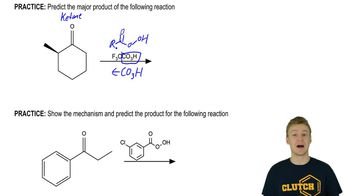
It converts ketones into esters and aldehydes into carboxylic acids.
What reagent is commonly used in Baeyer-Villiger oxidation?
MCPBA (meta-chloroperoxybenzoic acid) is commonly used as the peroxy acid.
What is migratory aptitude and why is it important in Baeyer-Villiger oxidation?
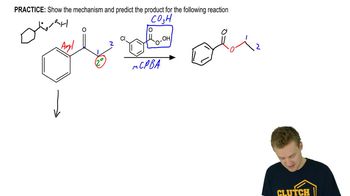
Migratory aptitude is the tendency of a group attached to the carbonyl to migrate during the reaction; it determines which group moves and where the oxygen is inserted.
List the migratory aptitude trend for groups attached to the carbonyl carbon.
The trend is: hydrogen > tertiary > secondary > aromatic > primary carbons.
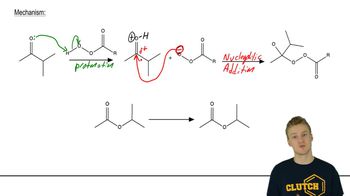
What are the three major steps in the Baeyer-Villiger oxidation mechanism?
The steps are protonation of the carbonyl oxygen, nucleophilic addition of the peroxy acid's conjugate base, and migration of the group with higher migratory aptitude.
What happens to the stereochemistry of the starting material in Baeyer-Villiger oxidation?
The stereochemistry is retained in the product, including the absolute configuration (R/S).
What is the final step in the Baeyer-Villiger oxidation mechanism?
The final step is deprotonation, resulting in a neutral product and a carboxylic acid byproduct.
What type of bond is formed during the migration step of Baeyer-Villiger oxidation?
A new bond is formed between the migrating group and the oxygen from the peroxy acid.
Why is Baeyer-Villiger oxidation considered unique among oxidation reactions?
It can further oxidize ketones, which are usually the most oxidized form in other reactions.
What determines which group migrates during Baeyer-Villiger oxidation?
The group with the highest migratory aptitude migrates to the oxygen atom.
What is the byproduct formed from the peroxy acid in Baeyer-Villiger oxidation?
A carboxylic acid is formed as a byproduct, derived from the peroxy acid used.
What is the role of the peroxy acid in Baeyer-Villiger oxidation?
The peroxy acid provides the oxygen atom that is inserted between the carbonyl carbon and the migrating group.
How does the Baeyer-Villiger oxidation affect the number of bonds to oxygen in the substrate?
It increases the number of bonds to oxygen in the substrate.
What happens to the hydrogen in an aldehyde during Baeyer-Villiger oxidation?
The hydrogen, having the highest migratory aptitude, migrates to the oxygen, forming a carboxylic acid.
What is the significance of the migration step in the Baeyer-Villiger mechanism?
The migration step is where the group with higher migratory aptitude moves to the oxygen, defining the regioselectivity of the reaction.