Organic Chemistry
My Course
Learn
Exam Prep
AI Tutor
Study Guides
Textbook Solutions
Flashcards
Explore
Try the app
My Course
Learn
Exam Prep
AI Tutor
Study Guides
Textbook Solutions
Flashcards
Explore
Try the app
Back
Baeyer-Villiger Oxidation definitions
You can tap to flip the card.
Baeyer-Villiger Oxidation
You can tap to flip the card.
👆
Baeyer-Villiger Oxidation
A reaction converting ketones to esters and aldehydes to carboxylic acids by inserting an oxygen atom using a peroxy acid.
Track progress
Control buttons has been changed to "navigation" mode.
1/15
Related flashcards
Related practice
Recommended videos
Baeyer-Villiger Oxidation quiz
Baeyer-Villiger Oxidation
15 Terms
19. Aldehydes and Ketones:Nucleophilic Addition - Part 1 of 3
5 topics
14 problems
Chapter
Johnny
19. Aldehydes and Ketones:Nucleophilic Addition - Part 2 of 3
1 topic
13 problems
Chapter
Johnny
19. Aldehydes and Ketones:Nucleophilic Addition - Part 3 of 3
2 topics
13 problems
Chapter
Ernest
Guided course
07:28
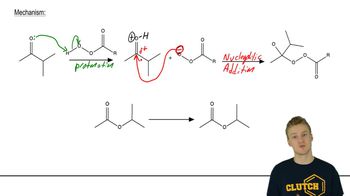
Mechanism:
2
views
Guided course
04:15
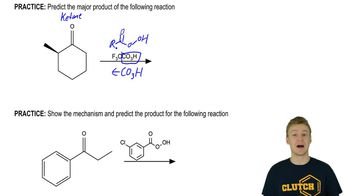
Predict The product:
2
views
Guided course
08:59
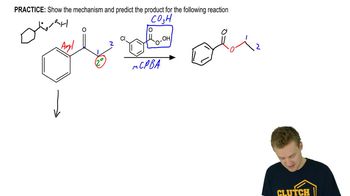
Show the mechanism:
2
views
Terms in this set (15)
Hide definitions
Baeyer-Villiger Oxidation
A reaction converting ketones to esters and aldehydes to carboxylic acids by inserting an oxygen atom using a peroxy acid.
Peroxy Acid
An oxidizing agent containing an extra oxygen atom, commonly used to insert oxygen into carbonyl compounds.
MCPBA
A widely used peroxy acid, meta-chloroperoxybenzoic acid, notable for its efficiency in oxygen insertion reactions.
Migratory Aptitude
A ranking of groups based on their tendency to shift during oxygen insertion, following the trend: H > tertiary > secondary > aromatic > primary.
Ketone
A carbonyl compound that, when oxidized in this reaction, forms an ester via oxygen insertion.
Aldehyde
A carbonyl compound that, upon oxidation, yields a carboxylic acid through oxygen insertion.
Ester
A functional group produced from a ketone after oxygen is inserted between the carbonyl and the migrating group.
Carboxylic Acid
A functional group formed from an aldehyde after oxygen insertion, increasing the oxidation state.
Migration
A key mechanistic step where a group shifts from the carbonyl carbon to an adjacent oxygen atom during the reaction.
Stereochemistry
The spatial arrangement of atoms, which remains unchanged throughout this oxidation process.
Absolute Configuration
The R/S designation of a chiral center, preserved during the reaction, ensuring product and reactant share the same configuration.
Protonation
The initial step where a carbonyl oxygen gains a proton, activating the molecule for further reaction.
Nucleophilic Addition
A mechanistic step where a nucleophile attacks the carbonyl carbon, forming a new bond and setting up migration.
Deprotonation
The final step where a proton is removed, yielding a neutral product and a carboxylic acid byproduct.
Regioselectivity
The preference for oxygen insertion at the position adjacent to the group with the highest migratory aptitude.