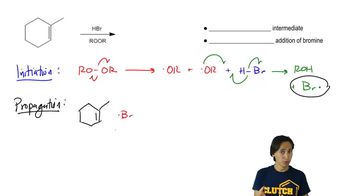
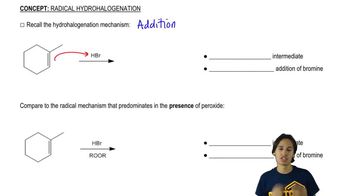
What is the key difference in the mechanism of hydrohalogenation when a radical initiator is present?
With a radical initiator, the mechanism shifts from carbocation-mediated to radical-mediated, involving initiation, propagation, and termination steps.
What is the role of peroxide in the anti-Markovnikov addition of HBr?
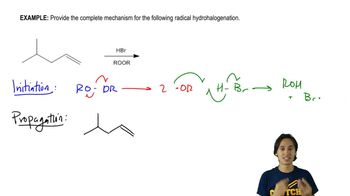
Peroxide acts as a radical initiator, generating radicals that start the radical chain mechanism.
During the initiation step, what radical is ultimately generated to start the anti-Markovnikov addition?
A bromine radical (Br·) is generated after peroxide reacts with HBr.
In the propagation step, to which carbon does the bromine radical add in the double bond?
The bromine radical adds to the less substituted carbon of the double bond.
Why does the bromine attach to the less substituted carbon in the radical mechanism?
This placement allows the resulting radical intermediate to be more stable, typically at the more substituted (tertiary) carbon.
What is the main product of the radical-mediated addition of HBr to an alkene?
The main product is an alkyl bromide with bromine attached to the less substituted carbon (anti-Markovnikov product).
How does the anti-Markovnikov addition of HBr differ from the Markovnikov addition in terms of product formation?
In anti-Markovnikov addition, bromine attaches to the less substituted carbon, while in Markovnikov addition, it attaches to the more substituted carbon.
What are the three main steps in the radical mechanism for anti-Markovnikov addition?
The three steps are initiation, propagation, and termination.
What happens during the termination step of the radical mechanism?
Radicals combine, such as two bromine radicals forming Br2, to end the chain reaction.
Why is the anti-Markovnikov addition of HBr considered significant in Organic Chemistry 1?
It is one of only two reactions in Organic Chemistry 1 that exhibit anti-Markovnikov addition, the other being hydroboration-oxidation.
What type of intermediate is formed in the radical mechanism of HBr addition with peroxide?
A radical intermediate is formed instead of a carbocation.
What is the effect of adding a radical initiator to a typical hydrohalogenation reaction?
It changes the reaction from a Markovnikov to an anti-Markovnikov addition.
What is the main termination product in the radical addition of HBr?
The main termination product is the combination of two bromine radicals to form Br2.
Which two reactions in Organic Chemistry 1 result in anti-Markovnikov addition?
The radical addition of HBr (with peroxide) and hydroboration-oxidation.
How can you recognize when a reaction will give anti-Markovnikov addition of HBr?
If the reaction uses HBr and a radical initiator (like peroxide), it will give anti-Markovnikov addition.
 Back
Back
 02:53
02:53