Skip to main content
Organic Chemistry
My Course
Learn
Exam Prep
AI Tutor
Study Guides
Textbook Solutions
Flashcards
Explore
Try the app
My Course
Learn
Exam Prep
AI Tutor
Study Guides
Textbook Solutions
Flashcards
Explore
Try the app
Back
Anti Markovnikov Addition of Br definitions
You can tap to flip the card.
Hydrohalogenation
You can tap to flip the card.
👆
Hydrohalogenation
An addition reaction where a double bond reacts with HBr, typically forming a Markovnikov alkyl halide.
Track progress
Control buttons has been changed to "navigation" mode.
1/14
Related flashcards
Related practice
Recommended videos
Anti Markovnikov Addition of Br quiz
Radical Hydrohalogenation
15 Terms
Anti Markovnikov Addition of Br
11. Radical Reactions
7 problems
Topic
Johnny
Free Radical Polymerization
11. Radical Reactions
1 problem
Topic
Johnny
11. Radical Reactions - Part 1 of 2
4 topics
11 problems
Chapter
Johnny
11. Radical Reactions - Part 2 of 2
5 topics
13 problems
Chapter
Johnny
02:53
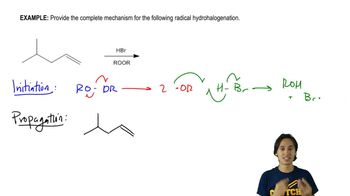
Provide the complete mechanism for the following radical hydrohalogenation.
8
views
07:13
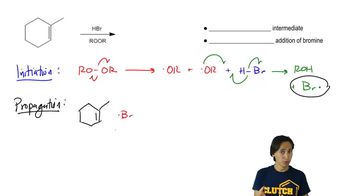
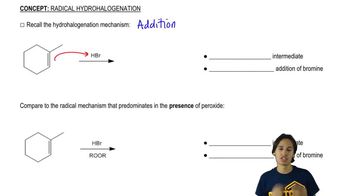
How Radical Hydrohalogenation is different from typical Hydrohalogenation.
4
views
01:18
Overview of Hydrohalogention.
5
views
Terms in this set (14)
Hide definitions
Hydrohalogenation
An addition reaction where a double bond reacts with HBr, typically forming a Markovnikov alkyl halide.
Markovnikov's Rule
A guideline stating that the most stable carbocation forms at the more substituted carbon during addition reactions.
Carbocation
A positively charged carbon intermediate formed during certain addition reactions, stabilized by adjacent alkyl groups.
Radical Initiator
A compound, such as peroxide, that generates radicals to start a radical chain reaction.
Peroxide
A specific radical initiator that decomposes to form oxygen-centered radicals, triggering radical mechanisms.
Initiation
The first step in a radical mechanism where radicals are generated from non-radical species.
Propagation
The sequence in a radical mechanism where radicals react with stable molecules to form new radicals and products.
Termination
The step in a radical mechanism where two radicals combine, ending the chain reaction.
Radical Intermediate
A highly reactive species with an unpaired electron, formed during radical-mediated reactions.
Anti-Markovnikov Addition
A process where a substituent attaches to the less substituted carbon of a double bond, opposite to Markovnikov's Rule.
Alkyl Halide
An organic compound where a halogen atom is bonded to an alkyl group, formed as the main product in these additions.
Bromine Radical
A bromine atom with an unpaired electron, crucial for the propagation step in radical additions.
Double Bond
A region of high electron density between two carbons, serving as the reactive site in addition reactions.
Hydroboration-Oxidation
A reaction sequence that also results in anti-Markovnikov addition, used as a comparison in the lesson.
 BackBack
 02:53
02:53