Back

Amino Acid Synthesis: HVZ Method quiz

Control buttons has been changed to "navigation" mode.
1/15
  • What does HVZ stand for in the context of amino acid synthesis?

    HVZ stands for the Hell–Volhard–Zelinsky reaction.
  • What is the first step in the HVZ method for amino acid synthesis?

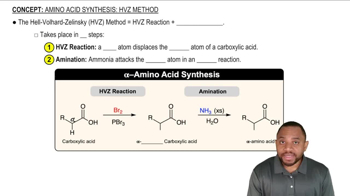
    The first step is the HVZ reaction, where a bromine atom replaces the alpha hydrogen of a carboxylic acid.
  • Which catalyst is used in the HVZ reaction to facilitate bromination?

    Phosphorus tribromide (PBr3) is used as the catalyst.
  • What is formed after the alpha hydrogen is replaced by bromine in the HVZ reaction?

    An alpha-bromo carboxylic acid is formed.
  • What is the nucleophile in the amination step of the HVZ method?

    Ammonia (NH3) acts as the nucleophile.
  • What type of reaction mechanism does ammonia use to replace bromine in the HVZ method?

    Ammonia performs an SN2 nucleophilic substitution.
  • What functional group is introduced to the alpha carbon during the amination step?

    An amino group (NH2) is introduced.
  • What is the final product of the HVZ method for amino acid synthesis?

    The final product is an alpha amino acid.
  • Which hydrogen is specifically replaced during the HVZ reaction?

    The alpha hydrogen of the carboxylic acid is replaced.
  • Why is the HVZ method important in organic synthesis?

    It demonstrates key concepts like nucleophilic substitution and alpha substitution, important for functional group transformations.
  • What role does bromine (Br2) play in the HVZ reaction?

    Bromine is the halogen that replaces the alpha hydrogen in the carboxylic acid.
  • What is the significance of the alpha carbon in the HVZ method?

    The alpha carbon is the site where substitution occurs, leading to amino acid formation.
  • What happens to the bromine atom during the amination step?

    The bromine atom is displaced by the amino group via SN2 substitution.
  • How many main steps are involved in the HVZ method for amino acid synthesis?

    There are two main steps: the HVZ reaction and the amination step.
  • What is the overall transformation achieved by the HVZ method?

    It converts a carboxylic acid into an alpha amino acid by sequential bromination and amination.