Back

Amino Acid Synthesis: HVZ Method definitions

Control buttons has been changed to "navigation" mode.
1/13
  • Hell–Volhard–Zelinsky Reaction

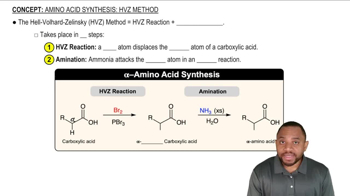
    A process where the alpha hydrogen of a carboxylic acid is replaced by bromine using phosphorus tribromide as a catalyst.
  • Alpha Hydrogen

    A hydrogen atom directly bonded to the carbon adjacent to the carboxylic acid group, targeted for substitution.
  • Carboxylic Acid

    An organic compound containing a carbonyl and hydroxyl group on the same carbon, serving as the starting material.
  • Phosphorus Tribromide

    A catalyst that facilitates the substitution of the alpha hydrogen with bromine in the HVZ reaction.
  • Alpha-Bromo Acid

    A compound formed when bromine replaces the alpha hydrogen of a carboxylic acid during the HVZ reaction.
  • Amination

    A step where ammonia introduces an amino group at the alpha position, replacing bromine via nucleophilic substitution.
  • Ammonia

    A nucleophile that attacks the alpha carbon, replacing bromine with an amino group in the second step.
  • SN2 Reaction

    A bimolecular nucleophilic substitution mechanism where ammonia displaces bromine from the alpha carbon.
  • Alpha Carbon

    The carbon atom directly adjacent to the carboxyl group, central to substitution in the HVZ method.
  • Amino Group

    A functional group (NH2) introduced at the alpha position, resulting in the formation of an amino acid.
  • Alpha Amino Acid

    A molecule containing both an amino and a carboxyl group attached to the same alpha carbon, synthesized via HVZ.
  • Nucleophilic Substitution

    A reaction type where a nucleophile, such as ammonia, replaces a leaving group like bromine on the alpha carbon.
  • Functional Group Transformation

    A process involving the conversion of one functional group to another, as seen in the HVZ method.