Back

Acylation of Aniline quiz

Control buttons has been changed to "navigation" mode.
1/15
  • Why is aniline considered the most activated benzene ring for electrophilic aromatic substitution (EAS)?

    Aniline is highly activated because its NH2 group strongly donates electrons to the ring, making it very reactive toward EAS.
  • What problem arises when performing nitration directly on aniline?

    Direct nitration of aniline often leads to polysubstitution due to its high reactivity, resulting in multiple nitro groups being added.
  • What is the purpose of protecting aniline before EAS reactions?

    Protection reduces aniline's reactivity, preventing unwanted multiple substitutions during EAS reactions.
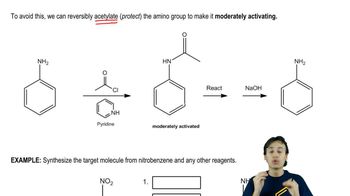
  • What is acetylation in the context of aniline chemistry?

    Acetylation is the process of adding an acyl group to aniline's nitrogen, making it less reactive for controlled substitution.
  • Which reagents are typically used to acetylate aniline?

    An acid chloride and a base like pyridine are used to acetylate aniline.
  • How does acetylation affect the activating strength of the NH2 group on aniline?

    Acetylation changes the NH2 group from strongly activating to moderately activating by attaching a carbonyl group.
  • Why is pyridine commonly used in the acetylation of aniline?

    Pyridine acts as a base to neutralize the HCl formed during acetylation, facilitating the reaction.
  • After acetylation, what is the preferred position for substitution on the aromatic ring and why?

    Substitution occurs mostly at the para position due to steric hindrance at the ortho positions.
  • What is the next step after performing the desired substitution on acetylated aniline?

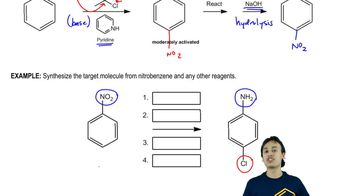
    The acetyl group is removed by hydrolysis with base, regenerating the free aniline.
  • What is hydrolysis in the context of deprotecting acetylated aniline?

    Hydrolysis is the process of removing the acetyl group from the nitrogen using a base, restoring the NH2 group.
  • Why is protection and deprotection important in aromatic substitution of aniline?

    Protection and deprotection allow for selective substitution and prevent unwanted side reactions on highly activated rings.
  • What would happen if you skipped the acetylation step before nitration of aniline?

    Skipping acetylation would likely result in polysubstitution, producing a mixture of products with multiple nitro groups.
  • Is the acetylation of aniline a reversible process?

    Yes, acetylation is reversible; the acetyl group can be removed by hydrolysis after substitution.
  • What is the main functional group added to aniline during acetylation?

    An acyl group, specifically an acetyl group (a two-carbon group with a carbonyl), is added to the nitrogen.
  • What general strategy should you always consider when planning EAS reactions on aniline?

    You should always consider protecting the amine group by acetylation to control reactivity and regioselectivity.