Back

Acidity of Aromatic Hydrocarbons quiz

Control buttons has been changed to "navigation" mode.
1/15
  • What is the typical pKa value of benzene, and what does this indicate about its acidity?

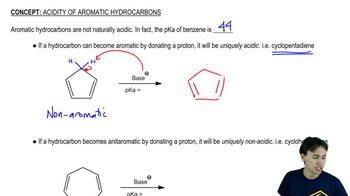
    Benzene has a pKa of about 44, indicating it is a very weak acid and a poor proton donor.
  • How can aromaticity influence the acidity of a hydrocarbon?

    Aromaticity can increase acidity if the molecule becomes aromatic after losing a proton, stabilizing the conjugate base.
  • What is the pKa of cyclopentadiene, and why is it unusually acidic for a hydrocarbon?

    Cyclopentadiene has a pKa of 15 because its conjugate base is aromatic and therefore highly stabilized.
  • Why is the conjugate base of cyclopentadiene especially stable?

    The conjugate base is aromatic, which provides extra stability due to delocalized electrons.
  • What happens to cyclopentadiene when a proton is removed?

    It becomes aromatic, which greatly increases the stability of its conjugate base.
  • How does the acidity of cyclopentadiene compare to water and alcohols?

    Cyclopentadiene is more acidic than water and alcohols because its conjugate base is aromatic.
  • What is the typical pKa of a normal sp3 hybridized C-H bond?

    The typical pKa is around 50, indicating very low acidity.
  • What happens to cycloheptatriene when it loses a proton?

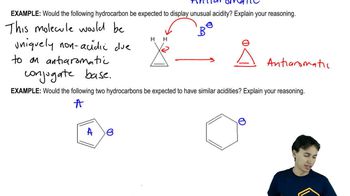
    It forms an anti-aromatic conjugate base, which is highly unstable.
  • What is the estimated pKa range for cycloheptatriene after losing a proton, and what does this mean?

    Its pKa is between 60 and 70, meaning it is extremely non-acidic and very difficult to deprotonate.
  • Why is the conjugate base of cycloheptatriene so unstable?

    Because it is anti-aromatic, which is even less stable than a typical carbanion.
  • What is the relationship between aromaticity and the stability of a conjugate base?

    Aromatic conjugate bases are much more stable than non-aromatic or anti-aromatic ones.
  • What is the main criterion for a molecule to be considered a good acid?

    A good acid forms a stable conjugate base after donating a proton.
  • How does aromaticity affect the ability of a molecule to donate a proton?

    If losing a proton makes the molecule aromatic, it becomes a much better proton donor.
  • What is the effect of forming an anti-aromatic conjugate base on acidity?

    Forming an anti-aromatic conjugate base makes the molecule extremely non-acidic.
  • Why are aromatic molecules generally not considered good acids or bases?

    Because their typical pKa values are very high, making them poor proton donors or acceptors unless aromaticity changes upon proton transfer.