Back

Acidity of Aromatic Hydrocarbons definitions

Control buttons has been changed to "navigation" mode.
1/14
  • Aromaticity

    A property granting exceptional stability to cyclic, planar molecules with delocalized pi electrons following specific electron count rules.
  • pKa

    A numerical value indicating the strength of an acid; lower values correspond to stronger acids and easier proton donation.
  • Conjugate Base

    A species formed when an acid donates a proton, whose stability often determines the original acid's strength.
  • Cyclopentadiene

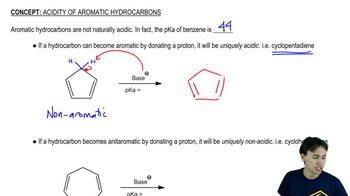
    A five-membered ring hydrocarbon that becomes highly acidic due to aromatic stabilization upon proton loss.
  • Cycloheptatriene

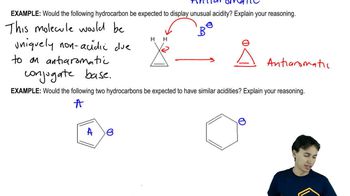
    A seven-membered ring hydrocarbon that becomes extremely non-acidic because its conjugate base is anti-aromatic.
  • Benzene

    A prototypical aromatic hydrocarbon with very low acidity, characterized by a high pKa and stable aromatic structure.
  • Proton Donor

    A molecule or ion capable of releasing a hydrogen ion, with effectiveness influenced by resulting conjugate base stability.
  • Anti-aromaticity

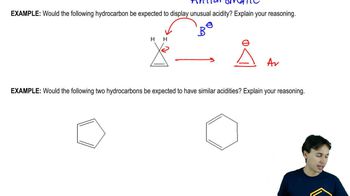
    A destabilizing property of cyclic molecules with certain electron counts, leading to high energy and low acidity.
  • Huckel's Rule

    A guideline stating that aromatic stability arises in planar rings with 4n+2 pi electrons, where n is an integer.
  • Carbanion

    A negatively charged carbon species, whose stability is greatly affected by aromatic or anti-aromatic character.
  • Hydrocarbon

    A compound composed solely of hydrogen and carbon, whose acidity can vary dramatically with structural changes.
  • Acidity

    A measure of a molecule's tendency to donate a proton, often influenced by the stability of its conjugate base.
  • Base

    A substance capable of accepting a proton, often used to test the acidity of organic molecules.
  • Delocalization

    The spreading of electrons across multiple atoms in a molecule, contributing to aromatic stability.