Back

Acid Chloride to Ketone quiz

Control buttons has been changed to "navigation" mode.
1/15
  • What is the key feature of acid chlorides and esters that allows them to undergo nucleophilic acyl substitution?

    They both have a good leaving group next to the carbonyl carbon.
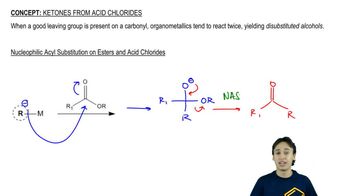
  • What happens when an organometallic reagent reacts with an acid chloride?

    The organometallic attacks the carbonyl carbon, forming a tetrahedral intermediate and eventually leading to the release of the leaving group.
  • Why do organometallic reagents typically react twice with acid chlorides or esters?

    Because after the first reaction forms a ketone, the organometallic can attack the new carbonyl again, leading to a disubstituted alcohol.
  • What is the name of the mechanism by which acid chlorides and esters react with nucleophiles?

    It is called nucleophilic acyl substitution (NAS).
  • What is the product when an acid chloride reacts twice with an organometallic reagent?

    The product is a disubstituted alcohol.
  • How can you prevent the reaction from going past the ketone stage when converting an acid chloride?

    By using a Gilman reagent (dialkylcuprate), which reacts only once and stops at the ketone.
  • What is a Gilman reagent also known as?

    A Gilman reagent is also called a dialkylcuprate.
  • What is the general formula for a Gilman reagent?

    It is typically written as (R)2CuLi, where R is an alkyl group.
  • Why does a Gilman reagent stop reacting after forming a ketone?

    Because Gilman reagents are weaker nucleophiles and do not react further with the ketone.
  • What leaving group is expelled when a Gilman reagent reacts with an acid chloride?

    The chloride ion (Cl-) is expelled.
  • What is the main advantage of using a Gilman reagent with acid chlorides?

    It allows for the selective formation of ketones without further reaction to alcohols.
  • What happens if you use a Grignard reagent instead of a Gilman reagent with an acid chloride?

    The Grignard reagent will react twice, leading to a disubstituted alcohol instead of stopping at the ketone.
  • What is the intermediate formed after the first nucleophilic attack on an acid chloride?

    A tetrahedral intermediate is formed.
  • Why is the second nucleophilic addition not observed with Gilman reagents?

    Because Gilman reagents are less reactive and do not attack the ketone formed after the first addition.
  • What is the final product when an acid chloride reacts with a Gilman reagent?

    The final product is a ketone.