Organic Chemistry
My Course
Learn
Exam Prep
AI Tutor
Study Guides
Textbook Solutions
Flashcards
Explore
Try the app
My Course
Learn
Exam Prep
AI Tutor
Study Guides
Textbook Solutions
Flashcards
Explore
Try the app
Back
Acid Chloride to Ketone definitions
You can tap to flip the card.
Acid Chloride
You can tap to flip the card.
👆
Acid Chloride
A carboxylic acid derivative with a chlorine atom as a leaving group, highly reactive toward nucleophilic attack.
Track progress
Control buttons has been changed to "navigation" mode.
1/13
Related flashcards
Related practice
Recommended videos
Acid Chloride to Ketone quiz
Acid Chloride to Ketone
15 Terms
19. Aldehydes and Ketones:Nucleophilic Addition - Part 1 of 3
5 topics
14 problems
Chapter
Johnny
19. Aldehydes and Ketones:Nucleophilic Addition - Part 2 of 3
1 topic
13 problems
Chapter
Johnny
19. Aldehydes and Ketones:Nucleophilic Addition - Part 3 of 3
2 topics
13 problems
Chapter
Ernest
Guided course
05:26
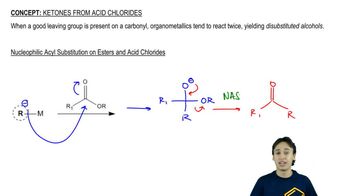
Ketones from acid chlorides
3
views
Terms in this set (13)
Hide definitions
Acid Chloride
A carboxylic acid derivative with a chlorine atom as a leaving group, highly reactive toward nucleophilic attack.
Ester
A carboxylic acid derivative containing an alkoxy group, also featuring a good leaving group for substitution reactions.
Ketone
A carbonyl compound with two alkyl groups attached to the carbonyl carbon, formed selectively from acid chlorides using specific reagents.
Nucleophilic Acyl Substitution
A mechanism where a nucleophile attacks a carbonyl carbon, forming a tetrahedral intermediate and replacing a leaving group.
Organometallic
A compound containing a metal bonded to a carbon, often used as a nucleophile in carbonyl addition reactions.
Tetrahedral Intermediate
A transient structure formed when a nucleophile adds to a carbonyl, temporarily disrupting the double bond.
Leaving Group
An atom or group that departs with a pair of electrons during a substitution, facilitating the reaction's progress.
Gilman Reagent
A dialkylcuprate organometallic, weaker than Grignard reagents, enabling selective formation of ketones from acid chlorides.
Dialkylcuprate
A copper-based organometallic with two alkyl groups, known for controlled reactivity in acyl substitution.
Grignard Reagent
A strong organometallic nucleophile that reacts twice with acid chlorides, typically yielding disubstituted alcohols.
Disubstituted Alcohol
A product formed when two identical alkyl groups add to a carbonyl, resulting from double organometallic addition.
Protonating Agent
A substance added after organometallic reactions to provide protons, finalizing the conversion to alcohols.
Carbonyl Carbon
The electrophilic center in acid chlorides and esters, targeted by nucleophiles during substitution.