Back

Acid-Catalyzed Alpha-Halogentation quiz

Control buttons has been changed to "navigation" mode.
1/15
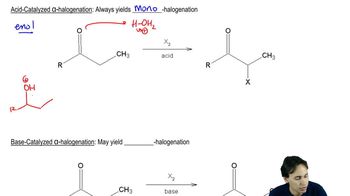
  • What is the key intermediate in acid-catalyzed alpha halogenation of carbonyl compounds?

    The key intermediate is the enol tautomer formed from the carbonyl compound.
  • Which catalyst is commonly used to promote enol formation in acid-catalyzed alpha halogenation?

    An acid such as H3O+ is used to promote enol formation.
  • What role does the enol tautomer play in acid-catalyzed alpha halogenation?

    The enol tautomer acts as a nucleophile and attacks the diatomic halogen molecule.
  • What is the result of the enol attacking a diatomic halogen in acid-catalyzed alpha halogenation?

    A halogen atom is substituted at the alpha position of the original carbonyl compound.
  • What happens to the intermediate after halogenation in acid-catalyzed alpha halogenation?

    The intermediate is deprotonated, reverting to the keto form and yielding the monohalogenated product.
  • Why does acid-catalyzed alpha halogenation typically result in monohalogenation rather than polyhalogenation?

    The presence of a halogen at the alpha position makes further halogenation less likely due to its electron-withdrawing effect.
  • How does the electron-withdrawing effect of the halogen influence enol formation after the first halogenation?

    It destabilizes the formation of additional enol tautomers, preventing further halogenation.
  • What is the difference in products between acid-catalyzed and base-catalyzed alpha halogenation?

    Acid-catalyzed alpha halogenation yields monohalogenation, while base-catalyzed can yield polyhalogenation.
  • What is the alpha position in a carbonyl compound?

    The alpha position is the carbon adjacent to the carbonyl carbon.
  • What is the final product of acid-catalyzed alpha halogenation?

    The final product is a monohalogenated carbonyl compound at the alpha position.
  • What is the function of water in the acid-catalyzed alpha halogenation mechanism?

    Water acts as a base to deprotonate the intermediate and restore the keto form.
  • Why is the enol tautomer considered a good nucleophile in this reaction?

    The enol tautomer has a double bond and lone pairs, making it reactive toward electrophiles like halogens.
  • What happens to the electrons when the enol attacks the halogen molecule?

    Electrons from the enol double bond attack the halogen, leading to halogen substitution at the alpha position.
  • What prevents the formation of a second enol after the first halogenation?

    The halogen's electron-withdrawing effect makes the alpha carbon less likely to form another enol.
  • What is the main purpose of acid-catalyzed alpha halogenation in organic synthesis?

    It introduces a halogen atom at the alpha position of a carbonyl compound, enabling further synthetic transformations.