Back

Acid-Catalyzed Alpha-Halogentation definitions

Control buttons has been changed to "navigation" mode.
1/13
  • Alpha Halogenation

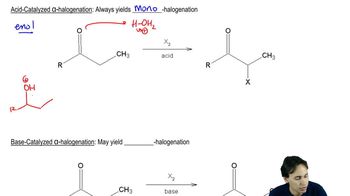
    Electrophilic substitution at the alpha position of a carbonyl, introducing a halogen atom via an enol intermediate.
  • Carbonyl Compound

    Molecule containing a carbon-oxygen double bond, serving as the starting material for enol formation.
  • Enol Tautomer

    Isomer with a hydroxyl group bonded to a carbon-carbon double bond, acting as a nucleophile in halogenation.
  • Acid Catalyst

    Substance like H3O+ that facilitates enol formation by protonating the carbonyl oxygen.
  • Nucleophile

    Species that donates an electron pair to an electrophile, such as the enol attacking a halogen molecule.
  • Diatomic Halogen

    Molecule consisting of two identical halogen atoms, serving as the electrophile in the reaction.
  • Alpha Position

    Location directly adjacent to the carbonyl group where halogen substitution occurs.
  • Monohalogenation

    Introduction of a single halogen atom at the alpha position, typical of the acid-catalyzed pathway.
  • Electron-Withdrawing Effect

    Influence of a halogen that decreases electron density at the alpha carbon, hindering further enol formation.
  • Deprotonation

    Removal of a proton from the intermediate, restoring the keto form after halogenation.
  • Keto Form

    Tautomer with a carbonyl group, regenerated after the reaction completes.
  • Intermediate

    Transient species formed after halogen addition but before deprotonation in the mechanism.
  • Conjugate Base

    Species formed when an acid donates a proton, often involved in deprotonating the intermediate.