Back

Acid-Base Properties of Amino Acids quiz

Control buttons has been changed to "navigation" mode.
1/15
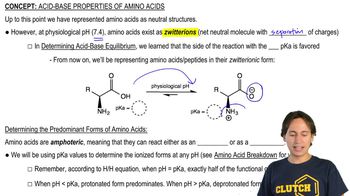
  • What is the predominant form of amino acids at physiological pH (~7.4)?

    Amino acids exist predominantly as zwitterions at physiological pH, meaning they have both positive and negative charges but an overall net charge of zero.
  • What does the term 'zwitterion' mean in the context of amino acids?

    A zwitterion is a molecule with both positive and negative charges that cancel out, resulting in a net neutral charge.
  • Why do amino acids exist as zwitterions at physiological pH instead of their neutral forms?

    Because the equilibrium favors the form where the hydrogen is on the group with the higher pKa, making the zwitterionic form more stable at physiological pH.
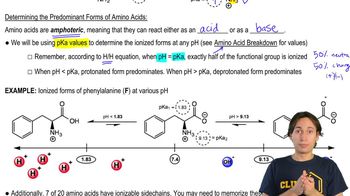
  • What are the typical pKa values for the carboxylic acid and amine groups in amino acids?

    The carboxylic acid group has a pKa around 2, and the amine group has a pKa around 9.
  • How does the Henderson-Hasselbalch equation relate to amino acid ionization?

    It tells us that when the pH equals the pKa of a group, that group is 50% ionized and 50% non-ionized.
  • What happens to the carboxylic acid group of an amino acid when the pH drops below its pKa?

    The carboxylic acid group becomes protonated, and the protonated form predominates.
  • What happens to the amine group of an amino acid when the pH rises above its pKa?

    The amine group becomes deprotonated, and the deprotonated (neutral) form predominates.
  • What does it mean for an amino acid to be amphoteric?

    It means the amino acid can act as either an acid or a base, depending on the environment.
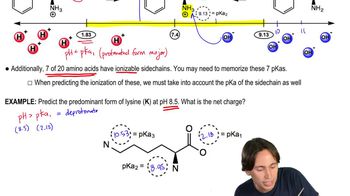
  • How do you determine the net charge of an amino acid at a given pH?

    You compare the pH to the pKa values of all ionizable groups (including side chains) to determine which groups are protonated or deprotonated, then sum the charges.
  • Which seven amino acids have ionizable side chains?

    Cysteine, tyrosine, aspartic acid, glutamic acid, lysine, histidine, and arginine.
  • Why is it important to know the exact pKa values for amino acid side chains?

    Because the ionization state and net charge of the amino acid depend on these values, especially at different pH levels.
  • What is the pKa of the side chain of lysine?

    The pKa of the lysine side chain is 10.53.
  • What is the pKa of the side chain of histidine?

    The pKa of the histidine side chain is 6.00.
  • How does the proximity of the side chain to the amino group affect the acidity of aspartic acid versus glutamic acid?

    Aspartic acid is more acidic than glutamic acid because its side chain is closer to the amino group, increasing the inductive effect.
  • What is the general rule for predicting whether a group on an amino acid will be protonated or deprotonated at a given pH?

    If the pH is below the pKa, the group is protonated; if the pH is above the pKa, the group is deprotonated.