Back

Acid-Base Properties of Amino Acids definitions

Control buttons has been changed to "navigation" mode.
1/15
  • Zwitterion

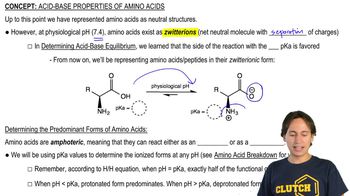
    A molecule with both positive and negative charges, resulting in an overall neutral charge, commonly seen in amino acids at physiological pH.
  • Physiological pH

    The typical pH value of body fluids, around 7.4, where amino acids predominantly exist in their zwitterionic form.
  • pKa

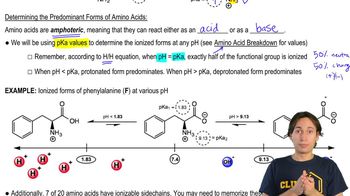
    A numerical value indicating the acidity of a functional group, crucial for predicting protonation states of amino acids.
  • Carboxylic Acid Group

    The acidic functional group in amino acids, usually with a pKa near 2, which can lose a proton to become negatively charged.
  • Amine Group

    The basic functional group in amino acids, typically with a pKa around 9, which can gain a proton to become positively charged.
  • Ionizable Side Chain

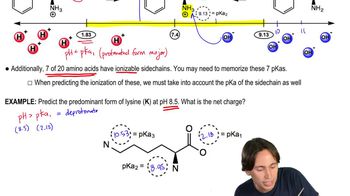
    A side group in certain amino acids that can gain or lose protons, adding complexity to their acid-base behavior.
  • Henderson-Hasselbalch Equation

    A relationship used to determine the ratio of protonated to deprotonated forms of a group based on pH and pKa.
  • Protonation State

    The status of a molecule or group regarding the presence or absence of a proton, influenced by pH and pKa.
  • Predominant Form

    The most stable or abundant structural state of an amino acid at a given pH, determined by comparing pH to pKa values.
  • Amphoteric Compound

    A molecule capable of acting as either an acid or a base, depending on the surrounding environment.
  • Net Charge

    The overall electrical charge of an amino acid, calculated by summing all positive and negative charges present.
  • Deprotonated Form

    A state where a group has lost a proton, often resulting in a negative charge, especially at high pH.
  • Protonated Form

    A state where a group has gained a proton, often resulting in a positive charge, especially at low pH.
  • Acid-Dissociation Constant

    A measure of the tendency of a group to lose a proton, directly related to its pKa value.
  • Equilibrium

    A state where the forward and reverse reactions occur at equal rates, determining the distribution of protonated and deprotonated forms.