Back

1H NMR:Spin-Splitting Simple Tree Diagrams quiz

Control buttons has been changed to "navigation" mode.
1/15
  • What is a coupling constant (J value) in 1H NMR spectroscopy?

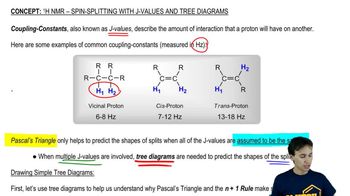
    A coupling constant (J value) quantifies the interaction between protons, measured in hertz (Hz). It describes how much one proton affects the splitting of another.
  • What are typical J values for vicinal, cis, and trans protons?

    Vicinal protons have J values of 6–8 Hz, cis protons 7–12 Hz, and trans protons 13–18 Hz. These are the most common coupling constants reviewed.
  • When does Pascal's Triangle accurately predict splitting patterns in NMR?

    Pascal's Triangle works when all J values involved in the splitting are the same. It fails when multiple, different J values are present.
  • Why is Pascal's Triangle not reliable when multiple J values are involved?

    Because different J values cause uneven splitting, Pascal's Triangle gives incorrect predictions. The resulting shapes are not the simple ratios it predicts.
  • What tool is used to visualize splitting when multiple J values are present?

    Tree diagrams are used to visualize proton splitting when different J values are involved. They provide a more accurate representation of the resulting split.
  • What does the n+1 rule predict in NMR splitting?

    The n+1 rule predicts the number of peaks in a splitting pattern based on the number of adjacent protons. For n adjacent protons, you get n+1 peaks.
  • In what situation is a tree diagram unnecessary for predicting NMR splitting?

    A tree diagram is unnecessary when all J values are the same. In this case, Pascal's Triangle and the n+1 rule are sufficient.
  • What is the predicted shape and ratio for a quartet according to Pascal's Triangle?

    A quartet has a ratio of 1:3:3:1. This shape is predicted when three equivalent protons split a target proton.
  • How does a tree diagram confirm the predicted quartet shape in a simple case?

    By sequentially splitting the singlet with each equivalent proton, the tree diagram shows merging lines and ratios matching Pascal's Triangle. The final ratio is 1:3:3:1, confirming a quartet.
  • What happens to the splitting pattern when protons have different J values?

    The splitting pattern becomes more complex and cannot be predicted by Pascal's Triangle. Tree diagrams must be used to visualize the actual pattern.
  • Why might a professor require you to learn tree diagrams in NMR?

    Tree diagrams are needed when splitting involves protons with different J values. They help visualize and predict complex splitting patterns.
  • What is the first step in drawing a tree diagram for NMR splitting?

    Start with a singlet representing the unsplit proton. Then, split it sequentially according to the coupling constants involved.
  • How do merged lines in a tree diagram affect the peak ratios?

    Merged lines increase the amplitude of the resulting peak, leading to ratios like 1:2:1 for a triplet. This reflects the number of overlapping splits.
  • What is the significance of the distance between splits in a tree diagram?

    The distance between splits corresponds to the J value (in Hz) for each coupling. It shows how far apart the peaks are in the spectrum.
  • When should you consult your professor about learning specific J values or tree diagrams?

    If your professor mentions J values or tree diagrams, ask if you need to know them for exams. Otherwise, focus on the simpler methods unless instructed.