Back

1H NMR:Spin-Splitting Simple Tree Diagrams definitions

Control buttons has been changed to "navigation" mode.
1/14
  • Spin Splitting

    Interaction between neighboring protons causing NMR signals to split into multiple peaks, revealing proton environments.
  • J Value

    Numerical measure, in hertz, of the coupling interaction between protons, determining the distance between split NMR peaks.
  • Coupling Constant

    Frequency difference between split NMR peaks, reflecting the strength of proton-proton interactions.
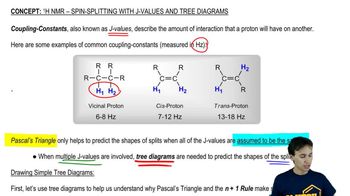
  • Vicinal Protons

    Non-equivalent protons on adjacent carbons, typically showing coupling constants of 6–8 Hz in NMR spectra.
  • Cis Protons

    Protons separated by a cis double bond, usually exhibiting coupling constants between 7–12 Hz.
  • Trans Protons

    Protons across a trans double bond, generally displaying coupling constants in the 13–18 Hz range.
  • Pascal's Triangle

    Mathematical tool predicting NMR splitting ratios when all coupling constants are identical.
  • Tree Diagram

    Visual method for mapping complex NMR splitting patterns, especially when multiple coupling constants are involved.
  • n+1 Rule

    Guideline stating that a proton split by n equivalent neighbors produces n+1 peaks in its NMR signal.
  • Quartet

    NMR splitting pattern with four peaks, typically showing a 1:3:3:1 intensity ratio.
  • Doublet

    NMR pattern with two peaks, resulting from splitting by one neighboring proton.
  • Triplet

    NMR pattern with three peaks, usually in a 1:2:1 ratio, from splitting by two equivalent protons.
  • Homotopic Protons

    Protons in identical chemical environments, leading to identical coupling constants in NMR splitting.
  • Singlet

    Single NMR peak, indicating no splitting due to absence of neighboring non-equivalent protons.