Back

1H NMR:Spin-Splitting (N + 1) Rule quiz

Control buttons has been changed to "navigation" mode.
1/15
  • What is spin splitting in proton NMR also known as?

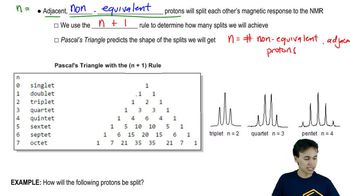
    Spin splitting is also known as spin-spin coupling, J coupling, or multiplicity.
  • What does the 'n' represent in the n+1 rule for NMR spin splitting?

    'n' represents the number of non-equivalent adjacent protons to the proton being analyzed.
  • According to the n+1 rule, what splitting pattern results when n = 0?

    When n = 0, the splitting pattern is a singlet, which appears as a single peak.
  • What splitting pattern do you expect when a proton has two non-equivalent adjacent protons?

    You would expect a triplet, which consists of three peaks.
  • How does Pascal's Triangle relate to NMR spin splitting?

    Pascal's Triangle predicts the relative heights of the peaks in a splitting pattern.
  • What is the splitting pattern for n = 3 according to the n+1 rule?

    For n = 3, the splitting pattern is a quartet, which has four peaks.
  • What are heteroatoms and how do they affect spin splitting in NMR?

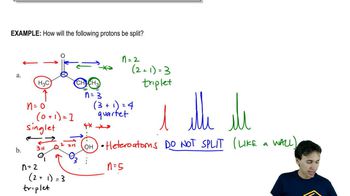
    Heteroatoms are non-carbon atoms like nitrogen, sulfur, or oxygen, and they act as a 'wall' that prevents splitting across them.
  • If a proton is adjacent to three equivalent protons, what multiplicity will its signal show?

    Its signal will show as a quartet due to the n+1 rule (3+1=4).
  • What is the pattern of peak heights for a triplet in NMR?

    The pattern of peak heights for a triplet is 1:2:1.
  • Why can't you split through a heteroatom in NMR analysis?

    Because heteroatoms block spin-spin coupling, acting as a wall that prevents splitting.
  • What is the splitting pattern called when n = 4, and what are the relative peak heights?

    When n = 4, the pattern is a quintet with relative peak heights of 1:4:6:4:1.
  • How do you determine the number of splits for a given proton in a molecule?

    Count the number of non-equivalent adjacent protons (n), then apply the n+1 rule.
  • What is the effect on splitting if there are no adjacent protons?

    There will be no splitting, resulting in a singlet.
  • What is the difference between the simple and complex methods of teaching spin splitting?

    The simple method uses the n+1 rule without J values, while the complex method includes J values and tree diagrams.
  • What does the term 'multiplicity' refer to in 1H NMR?

    Multiplicity refers to the number of peaks a proton signal is split into due to neighboring protons.