Back

1H NMR:Spin-Splitting (N + 1) Rule definitions

Control buttons has been changed to "navigation" mode.
1/14
  • Spin Splitting

    Interaction where neighboring protons influence each other's NMR signals, revealing spatial relationships between protons.
  • Spin-Spin Coupling

    Magnetic interaction between non-equivalent protons, causing the splitting of NMR peaks into multiple components.
  • J Coupling

    Quantitative measure of the interaction strength between coupled protons, often discussed with tree diagrams for complex analysis.
  • Multiplicity

    Pattern of peak splitting in NMR spectra, determined by the number of adjacent non-equivalent protons.
  • N + 1 Rule

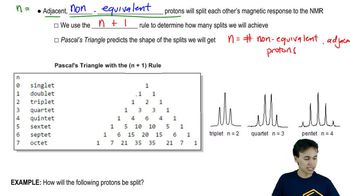
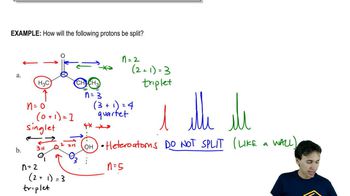
    Guideline stating that a proton with n adjacent non-equivalent protons will appear as a multiplet with n+1 peaks.
  • Pascal's Triangle

    Mathematical tool used to predict the relative intensities of split NMR peaks for different multiplicities.
  • Singlet

    NMR signal appearing as a single peak, indicating no adjacent non-equivalent protons.
  • Triplet

    NMR signal split into three peaks with intensity ratio 1:2:1, arising from two adjacent non-equivalent protons.
  • Quartet

    NMR signal split into four peaks with intensity ratio 1:3:3:1, due to three adjacent non-equivalent protons.
  • Quintet

    NMR signal split into five peaks with intensity ratio 1:4:6:4:1, resulting from four adjacent non-equivalent protons.
  • Heteroatom

    Non-carbon atom such as nitrogen, oxygen, or sulfur, which blocks spin splitting across its position in a molecule.
  • Adjacent Proton

    Hydrogen atom located on a neighboring carbon, influencing the splitting pattern of a target proton in NMR.
  • Non-Equivalent Proton

    Hydrogen atom in a distinct chemical environment, leading to unique NMR signals and splitting patterns.
  • Tree Diagram

    Visual representation used to map out complex splitting patterns when multiple coupling interactions are present.