Back

1H NMR:Q-Test quiz

Control buttons has been changed to "navigation" mode.
1/15
  • What is the general assumption about hydrogens on a single atom in proton NMR?

    The general assumption is that all hydrogens on a single atom share one peak on proton NMR.
  • What is the Q test in the context of proton NMR?

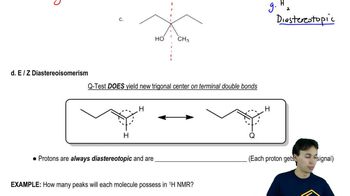
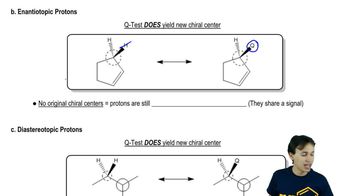
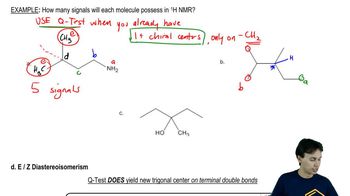
    The Q test involves replacing one hydrogen with the symbol Q and analyzing if the resulting carbon becomes a new chiral center.
  • What does it mean if the Q test does NOT generate a new chiral center?

    If the Q test does not generate a new chiral center, the protons are homotopic and considered equivalent.
  • What is the relationship between homotopic protons in proton NMR?

    Homotopic protons are equivalent and share a single signal on proton NMR.
  • Do you need to perform the Q test on CH3 groups? Why or why not?

    No, because CH3 groups always have two leftover hydrogens and cannot form a chiral center with the Q test.
  • What does it mean if the Q test generates a new chiral center and there are NO original chiral centers?

    The protons are enantiotopic and, for standard proton NMR, are considered equivalent and share a signal.
  • How does proton NMR typically treat enantiotopic protons?

    Proton NMR usually cannot distinguish between enantiotopic protons, so they appear as one signal.
  • What is the relationship called when the Q test generates a new chiral center and there ARE original chiral centers?

    The protons are diastereotopic and are non-equivalent.
  • How do diastereotopic protons appear on proton NMR?

    Diastereotopic protons receive separate signals on proton NMR.
  • When should you use the Q test according to the lesson?

    You should use the Q test only when the molecule has an original chiral center.
  • What is a chiral center in the context of the Q test?

    A chiral center is a carbon atom with four different groups attached to it.
  • What is the significance of the original chirality of a molecule in the Q test?

    The original chirality determines whether protons are homotopic, enantiotopic, or diastereotopic after the Q test.
  • Can advanced forms of proton NMR distinguish between enantiotopic protons?

    Yes, but only with special techniques like using a chiral solvent, which is beyond the scope of this course.
  • What is the only situation in which protons become non-equivalent in proton NMR?

    Protons become non-equivalent only when they are diastereotopic, meaning the Q test yields a new chiral center and the molecule had an original chiral center.
  • If a molecule has no original chiral center, what are the possible relationships between its protons after the Q test?

    The protons can only be homotopic or enantiotopic, both of which are considered equivalent in standard proton NMR.