Back

1H NMR:Q-Test definitions

Control buttons has been changed to "navigation" mode.
1/13
  • Proton NMR

    A spectroscopic technique that detects hydrogen environments in a molecule, revealing how many unique types of protons are present.
  • Chiral Center

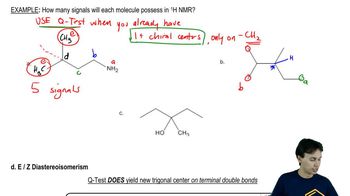
    A carbon atom bonded to four distinct groups, resulting in non-superimposable mirror images and molecular handedness.
  • Q Test

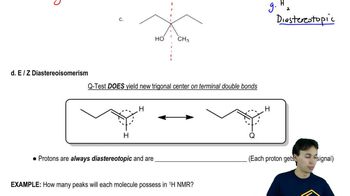
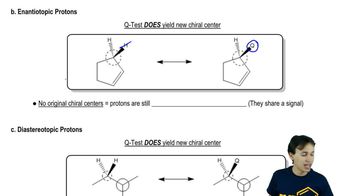
    A method where one hydrogen is replaced with a symbol to assess if a new chiral center forms, clarifying proton relationships.
  • Homotopic Protons

    Hydrogens that, when tested, do not create a new chiral center and are always chemically equivalent, sharing a single NMR signal.
  • Enantiotopic Protons

    Hydrogens that, when tested, create a new chiral center in a molecule lacking original chirality, but still appear equivalent in standard NMR.
  • Diastereotopic Protons

    Hydrogens that, when tested, create a new chiral center in a molecule already containing chirality, resulting in distinct NMR signals.
  • Signal Equivalence

    A situation where two or more hydrogens produce the same peak in NMR due to identical chemical environments.
  • Methyl Group

    A CH3 unit in organic molecules, whose hydrogens are always equivalent and do not require special testing for NMR analysis.
  • Chemical Environment

    The unique arrangement of atoms and bonds surrounding a hydrogen, determining its NMR signal.
  • Original Chirality

    The presence or absence of a chiral center in the starting molecule, which influences proton relationships after testing.
  • Non-equivalent Protons

    Hydrogens in different environments that produce separate signals in NMR, often due to molecular chirality.
  • Peak Splitting

    The phenomenon where NMR signals divide due to interactions between non-equivalent neighboring hydrogens.
  • Chiral Solvent

    A medium used in advanced NMR to distinguish between enantiotopic hydrogens, beyond standard undergraduate analysis.