Back

1H NMR:E/Z Diastereoisomerism quiz

Control buttons has been changed to "navigation" mode.
1/15
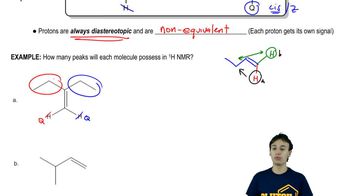
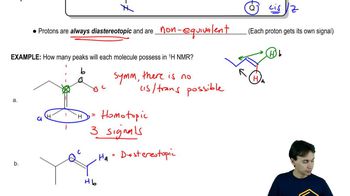
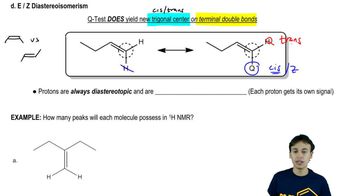
  • What is E/Z diastereoisomerism in the context of terminal double bonds?

    E/Z diastereoisomerism occurs when a terminal double bond forms a new trigonal center, allowing for cis (Z) and trans (E) isomers.
  • What is a trigonal center analogous to in isomerism?

    A trigonal center is analogous to the relationship between cis and trans isomers.
  • How does the q test relate to E/Z diastereoisomerism?

    The q test on a terminal double bond can yield different isomers depending on the position of the substituent, leading to E/Z diastereoisomerism.
  • What does it mean if hydrogens are diastereotopic in E/Z isomerism?

    Diastereotopic hydrogens are non-equivalent and will give different signals in NMR spectroscopy.
  • Why do E/Z diastereotopic hydrogens give different NMR signals?

    They give different signals because their proximity to substituent groups affects their shielding differently.
  • Which hydrogen is more shielded in a cis/trans (E/Z) relationship: cis or trans?

    The cis (Z) hydrogen is more shielded than the trans (E) hydrogen because it is closer to the substituent group.
  • Do you need a prior chiral center for hydrogens to be diastereotopic in E/Z isomerism?

    No, E/Z diastereotopicity does not require a prior chiral center.
  • How many NMR signals do diastereotopic hydrogens in E/Z isomerism produce?

    They produce two distinct NMR signals, one for each hydrogen.
  • What is the intuitive reason for non-equivalence of E/Z hydrogens in NMR?

    Their non-equivalence arises from their different distances to substituent groups, affecting their magnetic environment.
  • What happens to the NMR peaks if you replace a hydrogen with a q group on a terminal double bond?

    Replacing a hydrogen with a q group can create E or Z isomers, making the remaining hydrogens diastereotopic and giving them separate NMR peaks.
  • How does the position of a substituent (q) affect the isomer formed in a terminal double bond?

    Placing the substituent on different sides of the double bond creates either the cis (Z) or trans (E) isomer.
  • What is the relationship between shielding and the position of hydrogens in E/Z isomerism?

    The hydrogen closer to the substituent (cis) is more shielded, while the one further away (trans) is less shielded.
  • If two hydrogens on a terminal double bond are diastereotopic, will they share an NMR signal?

    No, diastereotopic hydrogens will not share an NMR signal; each will have its own distinct peak.
  • What is the effect of E/Z diastereoisomerism on the total number of NMR signals for terminal double bond hydrogens?

    E/Z diastereoisomerism increases the number of NMR signals because each hydrogen is in a unique environment.
  • Why is it important to practice determining if hydrogens are diastereotopic in E/Z isomerism?

    Practicing helps you predict the number of NMR signals and understand the molecular environment of each hydrogen.