Back

1H NMR:E/Z Diastereoisomerism definitions

Control buttons has been changed to "navigation" mode.
1/13
  • E/Z Diastereoisomerism

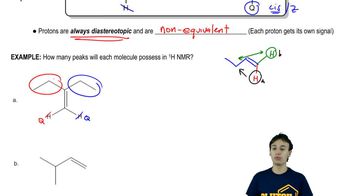
    Stereoisomerism in alkenes where substituents on a double bond create non-superimposable, non-mirror image forms.
  • Terminal Double Bond

    A carbon-carbon double bond located at the end of a carbon chain, often leading to unique stereochemical outcomes.
  • Trigonal Center

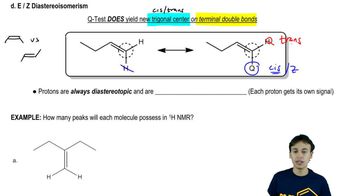
    A planar carbon atom in a double bond, serving as the reference point for E/Z or cis/trans isomerism.
  • Cis Isomer

    A configuration where similar groups are on the same side of a double bond, leading to increased shielding in NMR.
  • Trans Isomer

    A configuration where similar groups are on opposite sides of a double bond, resulting in decreased shielding in NMR.
  • Q Test

    A method for determining possible isomers by substituting a group at a double bond, revealing E/Z relationships.
  • Diastereotopic Hydrogens

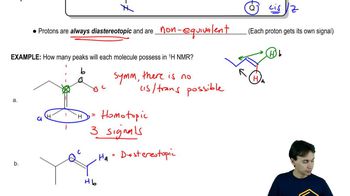
    Hydrogens in different spatial environments due to E/Z isomerism, producing distinct NMR signals.
  • Non-equivalence

    A situation where nuclei, such as hydrogens, experience different electronic environments and yield separate NMR peaks.
  • Shielding

    The effect where electron density around a nucleus reduces its exposure to the external magnetic field in NMR.
  • NMR Signal

    A resonance peak in nuclear magnetic resonance corresponding to a unique set of equivalent nuclei.
  • Substituent Group

    An atom or group of atoms attached to a molecule, influencing chemical shifts in NMR by altering local environments.
  • Cis/Trans Notation

    A system for describing the relative positions of groups across a double bond, analogous to E/Z notation.
  • E/Z Notation

    A nomenclature system distinguishing isomers based on the priority of groups attached to double-bonded carbons.