Ch. 11 - Properties and Synthesis of Alkyl Halides: Radical Reactions
Mullins - Organic Chemistry: A Learner Centered Approach 1st Edition
Mullins1st EditionOrganic Chemistry: A Learner Centered ApproachISBN: 9780137566471Not the one you use?Change textbook
Chapter 10, Problem 63a

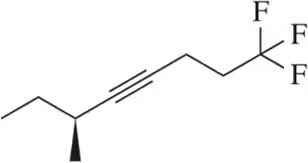
Predict the product of the following benzylic bromination reactions.
(a)

Verified step by step guidance
1
Identify the benzylic position in the given molecule. The benzylic position is the carbon atom directly attached to the benzene ring, which in this case is the carbon atom adjacent to the triple bond.
Understand that benzylic bromination typically involves the substitution of a hydrogen atom at the benzylic position with a bromine atom. This is due to the stability of the benzylic radical formed during the reaction.
Consider the reagents typically used for benzylic bromination, such as N-bromosuccinimide (NBS) in the presence of light or heat, which facilitates the formation of bromine radicals.
Predict the product by replacing the hydrogen atom at the benzylic position with a bromine atom. This involves breaking the C-H bond and forming a new C-Br bond at the benzylic position.
Ensure that the stereochemistry of the molecule is maintained, as benzylic bromination does not typically affect the stereochemistry of the rest of the molecule.

Verified video answer for a similar problem:

This video solution was recommended by our tutors as helpful for the problem above.
Video duration:
3m
Was this helpful?

Key Concepts

Here are the essential concepts you must grasp in order to answer the question correctly.

Benzylic Bromination

Benzylic bromination involves the selective substitution of a hydrogen atom at the benzylic position with a bromine atom, typically using N-bromosuccinimide (NBS) as the brominating agent. This reaction is favored due to the stability of the benzylic radical formed during the process, which is stabilized by resonance with the aromatic ring.
Recommended video:
Guided course
00:54
Mechanism of Allylic Bromination.

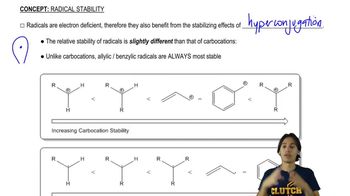
Radical Stability

Radical stability is crucial in benzylic bromination, as the reaction proceeds through a radical intermediate. Benzylic radicals are particularly stable due to resonance stabilization, where the unpaired electron can delocalize over the aromatic ring, reducing the energy of the radical and making the reaction more favorable.
Recommended video:
Guided course
03:43
The radical stability trend.

Resonance

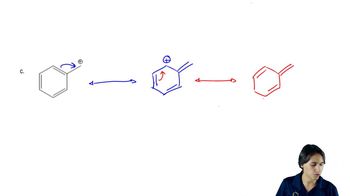
Resonance in organic chemistry refers to the delocalization of electrons across adjacent atoms, which can stabilize intermediates like radicals. In benzylic bromination, the benzylic radical benefits from resonance with the aromatic ring, allowing the electron density to be spread over multiple atoms, thus stabilizing the radical and facilitating the reaction.
Recommended video:
Guided course
03:04
Drawing Resonance Structures