Ch. 11 - Properties and Synthesis of Alkyl Halides: Radical Reactions
Mullins - Organic Chemistry: A Learner Centered Approach 1st Edition
Mullins1st EditionOrganic Chemistry: A Learner Centered ApproachISBN: 9780137566471Not the one you use?Change textbook
Chapter 10, Problem 64

The human body can excrete drugs and other exogenous molecules by converting them into polar, water-soluble compounds by a reaction similar to the autoxidation described in Section 11.6. Why are the following drug candidate molecules susceptible to oxidation by this pathway?

Verified step by step guidance
1
Identify the functional groups present in the drug candidate molecules. The first molecule contains a sulfonamide group and an amide group, while the second molecule contains a tertiary amine and an ether linkage.
Understand the concept of autoxidation. Autoxidation involves the reaction of molecules with oxygen, often leading to the formation of more polar, water-soluble compounds. This process is facilitated by the presence of certain functional groups that can stabilize radical intermediates.
Examine the sulfonamide group in the first molecule. Sulfonamides can undergo oxidation due to the presence of the sulfur atom, which can form sulfoxides or sulfones, increasing polarity.
Consider the tertiary amine in the second molecule. Amines can be oxidized to form N-oxides, which are more polar and water-soluble, facilitating excretion.
Evaluate the ether linkage in the second molecule. Ethers can be susceptible to oxidative cleavage, leading to the formation of alcohols or aldehydes, which are more polar and can be more easily excreted.

Verified video answer for a similar problem:

This video solution was recommended by our tutors as helpful for the problem above.
Was this helpful?

Key Concepts

Here are the essential concepts you must grasp in order to answer the question correctly.

Oxidation Reactions

Oxidation reactions involve the loss of electrons or an increase in oxidation state by a molecule. In organic chemistry, this often includes the addition of oxygen or the removal of hydrogen. These reactions are crucial for the metabolism of drugs, as they can convert lipophilic compounds into more polar, hydrophilic forms that are easier for the body to excrete.
Recommended video:
Guided course
03:20
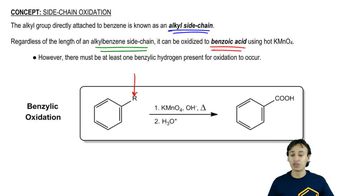
Benzylic Oxidation

Polar vs. Nonpolar Compounds

Polar compounds have a significant difference in electronegativity between atoms, leading to partial positive and negative charges, while nonpolar compounds do not have such charge separation. The human body tends to excrete polar compounds more efficiently because they are soluble in water, allowing for easier elimination through urine. Understanding the polarity of drug candidates helps predict their metabolic pathways.
Recommended video:
Guided course
01:40
Defining meso compounds.

Phase I Metabolism

Phase I metabolism refers to the initial chemical modifications made to drugs and other xenobiotics, primarily through oxidation, reduction, or hydrolysis. This process often introduces or exposes functional groups, making the compounds more polar and preparing them for further modification in Phase II metabolism, where conjugation occurs. Recognizing the role of Phase I reactions is essential for understanding how drugs are processed in the body.
Recommended video:
1:23
Intro to Metabolism Concept 1