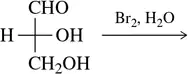
Predict the product of each of the following reactions. (c)
Verified step by step guidance
1
Identify the functional groups present in the starting material. The molecule has an aldehyde group (CHO) and two alcohol groups (OH).
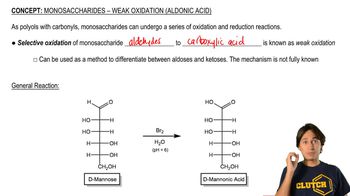
Recognize the reagent used in the reaction. Bromine in water (Br2, H2O) is typically used for the oxidation of aldehydes to carboxylic acids.
Understand the mechanism: Bromine water can oxidize the aldehyde group to a carboxylic acid. The reaction involves the formation of a bromohydrin intermediate, which is then hydrolyzed to form the carboxylic acid.
Predict the product: The aldehyde group (CHO) will be oxidized to a carboxylic acid group (COOH), while the alcohol groups remain unchanged.
Draw the structure of the product: The final product will have a carboxylic acid group in place of the aldehyde group, with the rest of the molecule remaining the same.
Verified video answer for a similar problem:
This video solution was recommended by our tutors as helpful for the problem above
Video duration:
1m
Play a video:
0 Comments
Key Concepts
Here are the essential concepts you must grasp in order to answer the question correctly.
Weak Oxidation
Weak oxidation involves mild oxidizing agents like Br2 in water, which selectively oxidize aldehydes to carboxylic acids without affecting other functional groups. In the context of monosaccharides, this reaction targets the aldehyde group, converting it to a carboxylic acid, while leaving the rest of the molecule intact.
An aldehyde group is characterized by a carbon atom bonded to a hydrogen atom and double-bonded to an oxygen atom (CHO). In organic chemistry, aldehydes are reactive and can be oxidized to form carboxylic acids. Understanding the reactivity of aldehydes is crucial for predicting the outcome of oxidation reactions.
Monosaccharides are the simplest form of carbohydrates, consisting of a single sugar unit with multiple hydroxyl groups and an aldehyde or ketone group. The structure of a monosaccharide determines its reactivity and the type of chemical reactions it can undergo, such as oxidation of the aldehyde group in the presence of Br2 and H2O.