
Draw and name the products of bromine water oxidation of (a) D-mannose (b) D-galactose (c) D-fructose
Verified step by step guidance
1
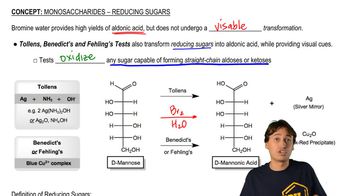
Understand the reaction: Bromine water is a mild oxidizing agent that selectively oxidizes the aldehyde group (-CHO) of aldoses to a carboxylic acid group (-COOH), forming aldonic acids. Ketoses, like D-fructose, do not directly react with bromine water but can isomerize to aldoses under the reaction conditions.
For (a) D-mannose: Identify the functional groups in D-mannose. It is an aldose with an aldehyde group at C1. Bromine water will oxidize the aldehyde group at C1 to a carboxylic acid group, forming D-mannonic acid. Draw the structure of D-mannonic acid by replacing the -CHO group at C1 with -COOH.
For (b) D-galactose: Similarly, D-galactose is an aldose with an aldehyde group at C1. Bromine water will oxidize the aldehyde group at C1 to a carboxylic acid group, forming D-galactonic acid. Draw the structure of D-galactonic acid by replacing the -CHO group at C1 with -COOH.
For (c) D-fructose: D-fructose is a ketose with a ketone group at C2. Under bromine water conditions, D-fructose can isomerize to D-glucose and D-mannose (both aldoses) via enediol intermediates. These aldoses are then oxidized by bromine water to their respective aldonic acids: D-gluconic acid and D-mannonic acid. Draw the structures of D-gluconic acid and D-mannonic acid.
Name the products: (a) The product of D-mannose oxidation is D-mannonic acid. (b) The product of D-galactose oxidation is D-galactonic acid. (c) The products of D-fructose oxidation are D-gluconic acid and D-mannonic acid.
Verified video answer for a similar problem:
This video solution was recommended by our tutors as helpful for the problem above
Video duration:
5m
Play a video:
0 Comments
Key Concepts
Here are the essential concepts you must grasp in order to answer the question correctly.
Bromine Water as an Oxidizing Agent
Bromine water is a solution of bromine in water, commonly used as an oxidizing agent in organic chemistry. It can oxidize alcohols and sugars, leading to the formation of carbonyl compounds. In the context of carbohydrates, bromine water can oxidize aldoses and ketoses, resulting in the formation of corresponding acids or other oxidized products.
Carbohydrates, such as D-mannose, D-galactose, and D-fructose, are organic compounds made up of carbon, hydrogen, and oxygen. They can exist in various forms, including aldoses (which contain an aldehyde group) and ketoses (which contain a ketone group). Understanding the structural differences between these sugars is crucial for predicting the products of their oxidation reactions.
Oxidation reactions in sugars involve the conversion of hydroxyl groups (-OH) to carbonyl groups (C=O) or the further oxidation to carboxylic acids. For example, D-mannose and D-galactose, being aldoses, can be oxidized to their corresponding aldonic acids, while D-fructose, a ketose, can be oxidized to a ketonic acid. Recognizing these transformations is essential for drawing and naming the products of the reactions.