Ch. 20 - Carboxylic Acids
Wade - Organic Chemistry 9th Edition
Wade9th EditionOrganic ChemistryISBN: 9780135213728Not the one you use?Change textbook
Chapter 20, Problem 20a

Draw the following sugars using Haworth projections:
a. β-D-galactopyranose

Verified step by step guidance
1
Understand the structure of β-D-galactopyranose: Galactose is a six-carbon aldose sugar (aldohexose) with the hydroxyl groups arranged in a specific stereochemistry. The 'β' designation indicates that the anomeric hydroxyl group is on the same side as the CH₂OH group in the Haworth projection.
Draw the basic pyranose ring: A pyranose is a six-membered ring structure containing five carbons and one oxygen. Start by sketching a hexagonal ring with an oxygen atom at the top-right corner.
Assign the substituents to the ring carbons: Number the carbons clockwise starting from the anomeric carbon (the carbon attached to the oxygen in the ring and the hydroxyl group). For β-D-galactopyranose, place the hydroxyl groups as follows: C1 has the hydroxyl group pointing up (β configuration), C2 has the hydroxyl group pointing up, C3 has the hydroxyl group pointing down, C4 has the hydroxyl group pointing up, and C5 has the CH₂OH group pointing up.
Add the hydrogen atoms: For each carbon atom, add a hydrogen atom opposite to the hydroxyl group to complete the structure. For example, if the hydroxyl group is pointing up, the hydrogen will point down, and vice versa.
Double-check the stereochemistry: Verify that the arrangement of hydroxyl groups matches the stereochemistry of D-galactose and that the β-anomeric configuration is correctly represented. Ensure the CH₂OH group at C5 is on the same side as the hydroxyl group at C1.

Key Concepts

Here are the essential concepts you must grasp in order to answer the question correctly.

Haworth Projections

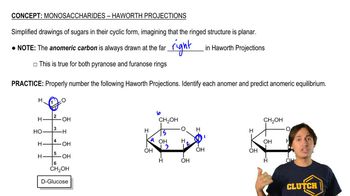
Haworth projections are a way to represent the cyclic forms of sugars, specifically their ring structures. In these projections, the sugar is depicted as a planar ring, with substituents shown above or below the plane to indicate their orientation. This method is particularly useful for visualizing the anomeric carbon and the stereochemistry of the sugar, which is crucial for understanding its reactivity and biological function.
Recommended video:
Guided course
04:03
Monosaccharides - Haworth Projections

Anomeric Carbon

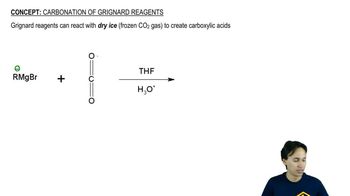
The anomeric carbon is the carbon atom in a sugar that was the carbonyl carbon in its open-chain form. In cyclic sugars, this carbon becomes a new stereocenter, leading to two possible configurations: alpha (α) and beta (β). The distinction between these forms is essential for understanding the properties and reactivity of sugars, as they can significantly influence the sugar's behavior in biochemical processes.
Recommended video:
Guided course
02:12
Carbonation of Grignard Reagents

D and L Configuration

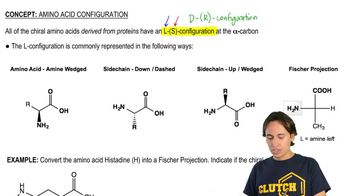
The D and L configuration of sugars refers to the orientation of the hydroxyl group on the penultimate carbon (the second-to-last carbon) in the Fischer projection. If the hydroxyl group is on the right, the sugar is designated as D; if on the left, it is L. This classification is important for identifying the sugar's stereochemistry and its biological role, as D-sugars are more commonly found in nature.
Recommended video:
Guided course
05:09
Representations of L-Configuration