Ch. 28 - Pericyclic Reactions
Bruice - Organic Chemistry 8th Edition
Bruice8th EditionOrganic ChemistryISBN: 9780135213711Not the one you use?Change textbook
Chapter 25, Problem 19

Does the [1,7] sigmatropic rearrangement that converts provitamin D3 to vitamin D3 involve suprafacial or antarafacial rearrangement?

Verified step by step guidance
1
Understand the [1,7] sigmatropic rearrangement: A sigmatropic rearrangement is a pericyclic reaction where a sigma bond migrates across a conjugated π-system. The [1,7] notation indicates that the migrating group moves from the first atom to the seventh atom in the conjugated system.
Analyze the molecular orbital symmetry: In a [1,7] sigmatropic rearrangement, the reaction involves the breaking and forming of sigma bonds while maintaining the π-system. The reaction's stereochemistry depends on whether the rearrangement is suprafacial (same face of the π-system) or antarafacial (opposite face of the π-system).
Consider the geometry of the system: For a [1,7] rearrangement, the π-system spans a significant distance. An antarafacial rearrangement would require the system to adopt a highly strained geometry, which is typically unfavorable in such large systems.
Apply the Woodward-Hoffmann rules: These rules predict the stereochemistry of pericyclic reactions based on orbital symmetry. For a [1,7] sigmatropic rearrangement, the reaction is thermally allowed and typically proceeds via a suprafacial pathway due to the favorable orbital overlap and lower strain.
Conclude the stereochemical pathway: Based on the analysis, the [1,7] sigmatropic rearrangement that converts provitamin D3 to vitamin D3 involves a suprafacial rearrangement, as this is the most favorable pathway for this reaction.

Verified video answer for a similar problem:

This video solution was recommended by our tutors as helpful for the problem above.
Was this helpful?

Key Concepts

Here are the essential concepts you must grasp in order to answer the question correctly.

Sigmatropic Rearrangement

Sigmatropic rearrangements are a class of pericyclic reactions where a sigma bond is broken and reformed, resulting in the migration of a substituent. These reactions can be classified based on the orientation of the migrating group relative to the original bond, leading to suprafacial or antarafacial pathways. Understanding the mechanism of these rearrangements is crucial for predicting the product structure and stereochemistry.
Recommended video:
Guided course
03:20
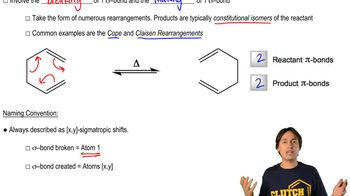
Nomenclature of Sigmatropic Shifts

Suprafacial vs. Antarafacial Rearrangement

In a suprafacial rearrangement, the migrating group moves along the same face of the molecule, maintaining its orientation relative to the original bond. Conversely, an antarafacial rearrangement involves the migrating group moving to the opposite face, which can lead to different stereochemical outcomes. Identifying which type of rearrangement occurs is essential for understanding the reaction mechanism and the final product.
Recommended video:
Guided course
06:08
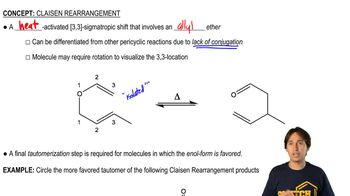
Definition of Claisen Rearrangement

Provitamin D3 to Vitamin D3 Conversion

The conversion of provitamin D3 to vitamin D3 involves a [1,7] sigmatropic rearrangement, where the structure undergoes a shift in the position of the double bond and the associated substituents. This transformation is significant in biochemistry as it relates to the synthesis of vitamin D3, which plays a vital role in calcium metabolism and bone health. Analyzing the rearrangement type helps in understanding the reaction's stereochemical implications.
Recommended video:
Guided course
04:30
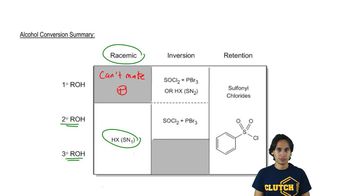
Comparing and contrasting the Alcohol Conversions.