Ch. 16 - Reactions of Aldehydes and Ketones • More Reactions of Carboxylic Acid Derivatives
Bruice - Organic Chemistry 8th Edition
Bruice8th EditionOrganic ChemistryISBN: 9780135213711Not the one you use?Change textbook
Chapter 17, Problem 60e

Using cyclohexanone as the starting material, describe how each of the following compounds can be synthesized:
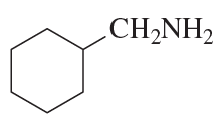
e. Cyclohexanone structure with an attached amine group, illustrating reductive amination synthesis.

Verified step by step guidance
1
Step 1: Begin with cyclohexanone as the starting material. Cyclohexanone is a ketone with a six-membered ring structure. The goal is to convert the ketone group into a tertiary amine group attached to the ring.
Step 2: Perform reductive amination. Reductive amination is a common method to introduce an amine group onto a ketone. React cyclohexanone with a primary or secondary amine, such as methylamine, in the presence of a reducing agent like sodium cyanoborohydride (NaBH3CN) or hydrogen gas with a metal catalyst.
Step 3: Ensure the reaction conditions favor the formation of the tertiary amine. Use excess methylamine to ensure that the nitrogen atom is fully substituted with three methyl groups, resulting in the desired tertiary amine structure.
Step 4: Purify the product. After the reaction is complete, isolate the tertiary amine product using techniques such as distillation or chromatography to remove any unreacted starting materials or by-products.
Step 5: Confirm the structure of the synthesized compound. Use spectroscopic methods such as NMR (Nuclear Magnetic Resonance) and IR (Infrared Spectroscopy) to verify the presence of the tertiary amine group and the cyclohexane ring structure.

Verified video answer for a similar problem:

This video solution was recommended by our tutors as helpful for the problem above.
Video duration:
3m
Was this helpful?

Key Concepts

Here are the essential concepts you must grasp in order to answer the question correctly.

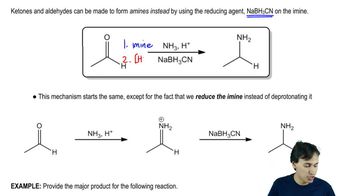
Reductive Amination

Reductive amination is a chemical reaction that involves the conversion of a carbonyl compound, such as a ketone or aldehyde, into an amine. This process typically involves the formation of an imine or enamine intermediate, which is then reduced to yield the corresponding amine. In the context of cyclohexanone, this reaction can be used to synthesize amines by reacting it with an amine and a reducing agent.
Recommended video:
Guided course
07:12
Reductive Amination

Cyclohexanone

Cyclohexanone is a cyclic ketone with the molecular formula C6H10O. It is a colorless liquid with a distinctive odor and is commonly used as a solvent and in the production of nylon. In organic synthesis, cyclohexanone serves as a versatile starting material for various transformations, including the synthesis of amines through reductive amination.
Recommended video:
Guided course
01:20
Is the following disubstituted cyclohexane chiral?

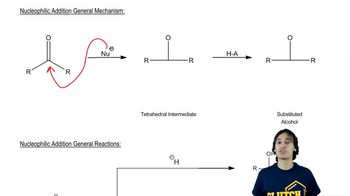
Nucleophilic Addition

Nucleophilic addition is a fundamental reaction mechanism in organic chemistry where a nucleophile attacks an electrophilic carbon atom, typically found in carbonyl compounds. In the case of cyclohexanone, the carbonyl carbon is electrophilic, allowing nucleophiles, such as amines, to add to it. This step is crucial in forming the imine intermediate during reductive amination.
Recommended video:
Guided course
08:27
Nucleophilic Addition