Ch. 16 - Aromatic Compounds
Wade - Organic Chemistry 9th Edition
Wade9th EditionOrganic ChemistryISBN: 9780135213728Not the one you use?Change textbook
Chapter 16, Problem 16c

Draw resonance forms to show the charge distribution on the pyrrole structure.

Verified step by step guidance
1
Step 1: Recognize the pyrrole structure. Pyrrole is a five-membered aromatic ring containing one nitrogen atom. The nitrogen has a lone pair of electrons, and the ring is conjugated with alternating double bonds.
Step 2: Understand resonance in aromatic systems. Resonance occurs when electrons can delocalize across the conjugated system, stabilizing the molecule. In pyrrole, the lone pair on nitrogen can participate in resonance with the π-electrons of the ring.
Step 3: Draw the first resonance form. In this form, the lone pair on nitrogen moves to form a double bond between nitrogen and one of the adjacent carbon atoms. This causes the double bond in the ring to shift, creating a new resonance structure.
Step 4: Draw the second resonance form. In this form, the double bond from the previous step shifts further around the ring, and the negative charge appears on a different carbon atom. This continues the delocalization of electrons.
Step 5: Draw the third resonance form. The double bond shifts again, placing the negative charge on yet another carbon atom. This completes the set of resonance structures for pyrrole, showing how the charge is distributed across the ring.

Verified video answer for a similar problem:

This video solution was recommended by our tutors as helpful for the problem above.
Video duration:
7m
Was this helpful?

Key Concepts

Here are the essential concepts you must grasp in order to answer the question correctly.

Resonance Structures

Resonance structures are different Lewis structures for the same molecule that illustrate the delocalization of electrons. In the case of pyrrole, resonance forms show how the nitrogen atom can share its lone pair with the π system of the ring, leading to multiple valid representations of the molecule's electron distribution.
Recommended video:
Guided course
03:04
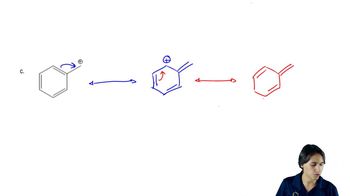
Drawing Resonance Structures

Aromaticity

Aromaticity refers to the enhanced stability of cyclic compounds with conjugated π electrons that follow Hückel's rule (4n + 2 π electrons). Pyrrole is aromatic due to its five-membered ring containing a nitrogen atom, which contributes to the π system, allowing for resonance stabilization and unique chemical properties.
Recommended video:
Guided course
08:19
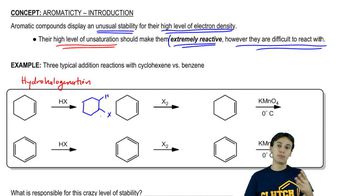
Intro to Aromaticity

Charge Distribution

Charge distribution in a molecule refers to how electron density is spread across its atoms. In pyrrole, the resonance forms illustrate that the charge is not localized but rather delocalized over the ring, affecting its reactivity and interactions with other molecules, particularly in electrophilic aromatic substitution reactions.
Recommended video:
Guided course
01:34
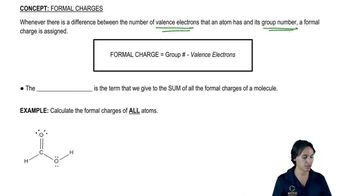
Calculating formal and net charge.